Nursing home

The nursing home smelled of stale urine and had the wallpaper of a 1970s mental home, with calm colors and a bland boarder of flowers. An elderly lady clutched a baby doll with blue eyes and a prim smile as she rolled her wheel chair down the hall.  

“The baby’s smiling at you,” my uncle Matt said, pointing to the doll with a quiet chuckle. 

I smiled. Televisions droned in the background, filtering into the hall from open doors and an alarm sounded. 

“What do you think that alarm is?” my dad said. 

“Someone probably trying to get out,” said Matt with the same quiet chuckle. 

My dad nodded. 

A young nurse with blond hair pulled out of the room. Without smiling she said, “All set.”

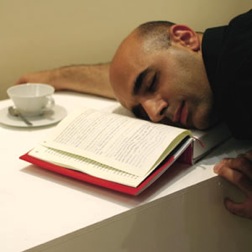
We walked inside. My grandfather smiled as he saw us enter. He wore a blue woolen cap, khakis, and a striped blue shirt. His face looked like putty molded into a face–sunken cheeks, eyes dazed, mouth loosely hanging–and his body had skin stretched taut over thin bones. He was gray and tired. I shook his hand, a vague clasp that hung in my palm.

“Hey Grampa, nice to see you,” I said.
Continue reading “Nursing home”

Travel

I just got back from a few days on the road. I spent some time with friends and canoed for a bit, then stayed with an old friend (from fourth grade) in Cornell since Sunday. He’s an RA there and is spending the week looking after the seniors before the graduate. Really, he just wants to see his girlfriend, I think.  

It gave me time to break my stagnation at home and sketch a few ideas for another essay. I hope to start it soon–ideally tomorrow. I finished some major edits on a short story today and hope to send that out as well. Writing, reading, traveling, writing. It seems like there should be formula somewhere. 

As I sketch out my essay and review the notes I made during my trip, I hope to write more about travel, but in the mean time, here’s a sketch since I haven’t posted in a few days. 

Continue reading “Travel”

Novel

I started on my novel again Monday. I began it during my winter break from mid-December to mid-January, then Imagetook a hiatus during school. I’ve been home for summer for about a week, but spent most of last week finishing final essays and creative writing assignments for classes and proofreading a literature magazine.

It felt great to hit the page again.

I’m going back to the beginning, editing to where I left off and resuming with all the threads in mind. It’s about 50,000 words now, which is about the length of The Great Gatsby. I aim to make it about 100,000, the typical soft-cover length.

So far, working on the novel has been hard but rewarding, especially since I’m neither a professional writer nor do I know what I’m going to do with it. But it begs completion. That’s enough.

Continue reading “Novel”

Insomnia time

ImageLast night I had a horrific case of insomnia. It hits me now and then, but it’s not regular–at least not normally. When I was in high school, I would sneak out through the garage–the front and back doors squeaked–and walk around my neighborhood. I’m blessed by a secure ring of suburbia, so I was never afraid. I watched the cars sail along the road and the televisions coloring the windows.

I descovered a word for it a few years ago:  “noctivagant,” night wandering. 

The time of an insomniac differs than a day-dweller. It seems to expand when we have nothing to fill it with, like long Sundays or silent miles passing down a long road. It’s looser, less rigid. Free. 

Sometimes I picture time like a flag on windy day, straining to break away from its pole. It rips away and glides high and free, untethered. Such is insomnia time. 

Continue reading “Insomnia time”

Non-economic labels

Image
from “Stealth of Nations,” a blog by Robert Neuwirth

I just finished Monoculture: How One Story is Changing Everything, a recent book by writer and researcher F.S. Michaels. She details how an economic view of the world shapes our lives at the expense of other views. The “economic story,” as she calls it, is a way of viewing the world that takes specific biases for reality: mainly that we’re rational individuals with selfish needs behaving in an indifferent market system.

Our world expects us to conform to this monoculture and we hardly notice its pervasive dominance.

It was a fascinating book, and I hope to have a review up this week, but I read it thinking of my own self-proscribed label as a “writer.”

Continue reading “Non-economic labels”

The nearness of the distant

I’ve done a bad job updating this blog so far, so I’m going for a shift of focus: I’m going to make it more personal. I apologize for the gaps in posts so far. Scouts honor–and I was a Boy Scout–I’m going to post more regularly from now on. So to get to business…

I’m nearing my final weeks of junior year. Clouds cover the sky like a rumpled old blanket, sapping color from the St. Bonaventure campus. I imagine Heidegger walking by the nearby river on such days, his steel gray hair matching the clouds, his footsteps lagging as a new thought turns over in his head. He was a heavy guy. Even his name. Heidegger.

I’m writing a paper, drawing from an essay he wrote: “Who is Zarathurstra?” He analyzes the unity he sees between Nietzsche’s concepts of “overman” and “eternal recurrence,” doctrines threaded through Nietzsche’s works. The ideas are heavy, sunken cathedrals built on traditions of metaphysics dating back to Plato.

Through the dry but brilliant essay, a line stands out: “Longing is the agony of the nearness of the distant.”

Sometimes philosophy has poetry wedged between the arguments; the line captures my mood during these final weeks.

Continue reading “The nearness of the distant”

Philosophical Journalism

Philosophical journalists would be an interesting breed. I don’t mean bent, bearded men toting reporters’ notebooks and tape recorders stumbling across Capital Hill–although that would be interesting. Nor do I mean reporters jabbing politicians with barbs about how the latest bill violates Kant’s categorical imperative. Instead, I imagine people curious to see what other people think, people who like asking questions about our basic assumptions.

Today, I watched a documentary called the “Nature of Existence.” The filmmaker, named Roger Nygard, chronicles answers to those “big questions”–like the meaning of life–by interviewing people from around the world, including hard-core Indian ascetics, fiery evangelists, physicists, artists, and waitresses. Some dash off the questions with a humorous observation, others admit their own ignorance, and some weave stories substantiated by absolute conviction.

His methods are those of a journalist, but his focus is on first principles, the realm of the philosopher.

Scanning titles in the non-fiction and creative nonfiction shelves at bookstores, I realize modern readers still have a lot of questions. We like to pretend we are practical these days, zeroed in on the nuts and bolts of economics and applied science. But I feel we only use new disciplines to fill an age-old void: purpose and meaning.

Continue reading “Philosophical Journalism”

Water droplets

Sometimes I sit and watch water drops form and fall in the sink. One at a time. A small bead gathers on the faucet’s tip, its surface swarming with the water. Then it begins to fall, stretching into a strained neck that clips itself apart and separates into a falling droplet.

For those brief milliseconds, a world forms on the tense surface of the drop. It’s not attached to anything. An individual drop. At first I thought of the literal world of microbes and particulates swarming and whirring through the bead, like H.G. Wells describes at the opening of the War of the Worlds, “transient creatures that swarm and multiply in a drop of water.”

The rotifers and paramecium stretch and move along the drop, but then their world shatters like falling glass and rolls down the drain.

I soon imagined a world like ours: skyscrapers, cathedrals, complicated ideas. The infusoria building houses, getting an education, pondering their future, framing an ethical code, “finding themselves,” getting married, divorcing, fighting, killing, preaching, and dying amid the ritual and fanfare of civility. Then their world fragments and drains away.  
Continue reading “Water droplets”

Magic

I just finished writing a short story that I started last Thanksgiving. I’ve been picking at it the last few days over my spring break, trying to clinch it. I wrote a novel over my winter break and worked on some essays for scholarships, preventing it then, and thus far, my semester has been too packed to do anything but proofread.

So, finishing it leaves a perfect time to talk about “magic.”

Over winter break, I developed a schedule: wake up early, finish my routine, make a pot of tea, light a candle, open a window and write from 8 to 12 and break for lunch. Nonstop. If I had to use the bathroom, I made it quick. My parents didn’t really get it. They thought I was being asocial or avoiding them out of anger, or that my time up there  was lonesome.

I loved it. I enjoy people, but that four-hour time alone facing the page was something far better. That’s the magic of writing: that healing, redemptive, almost mystic struggle to draw words into the world. To me, nothing else comes close.

Continue reading “Magic”

A word on writing: Craft

Before shifting to philosophy, I was a journalism major. My passion was and remains writing and reading, although my topics have shifted over the years. I read grammar books for fun now and then, and get excited over a well-placed comma or a finite distinction, the difference between farther and further or prophesy and prophecy, for example. I think in words and try to pin down everything I can into coherent syntax. I recognize this has limits, but it’s how I process the world. Besides, language has immense expressiveness.

I have no other credentials than an ongoing college education; a passion for the page; a computer weighted down with essays, poems, short stories, and half-finished novels; and an exhaustive reading list. But I hope my opinion has some depth to it, and can entertain–or interest–a reader.

I think writing is a craft and a type of magic, a dichotomy made by Carl Sessions Stepp in his book Writing as Craft and Magic. Today, I’d like to talk about the first part: craft.

Continue reading “A word on writing: Craft”