Solitude and Loneliness

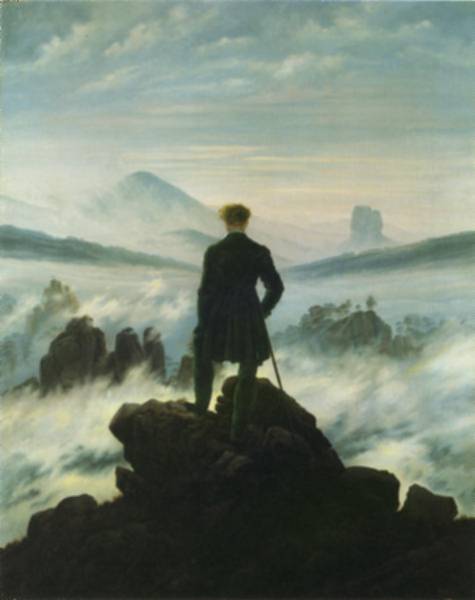
A friend recently mentioned in a message to me that she doesn’t mind spending time alone anymore. As she put it, “I’ve gotten to the point where I don’t feel like I’m a loser when I’m alone.” She even described a moment walking home in the rain alone without a raincoat or umbrella. Wanderer_above_the_Sea_of_Fog
“People driving by probably thought I was miserable, but I just smiled the entire time like I had a big secret that I couldn’t tell anyone,” she wrote. “The rain was so refreshing.”

I suppose the millennial generation feels particularly pressured to avoid “being alone.” We’re increasingly connected with cell phones and social networks. A “lonely person” conjures images of a Friday-night recluse in a concrete room with cold fluorescent lights pouring down on a clammy floor strewn with old magazines. Meanwhile, everyone he knows–even the smelly kid with the sketchy sweatshirt who sat near him on the bus in third grade–is at some party with Aziz Ansari and David Tennent, having a great time. FOMO, it’s called: “fear of missing out”

We fear being alone because we fear loneliness: the sense of exclusion, the shame, the boredom. But you don’t have to be alone to feel alone. It can hit anywhere, even at a party.

And sometimes being alone doesn’t mean you feel lonely. As my friend realized, being alone can be empowering. Even fun. As theologian Paul Tillich notes in The Eternal Now, “Our language has wisely sensed these two sides of man’s being alone. It has created the word ‘loneliness’ to express the pain of being alone. And it has created the word ‘solitude’ to express the glory of being alone.

But what’s the difference?

Continue reading “Solitude and Loneliness”

Starlight and renewal

Sometimes, when I’m tired or lost I look at old writing. It reminds me where I camestars1.jpg from, what has always mattered, and where I ought to go. Today, as I struggled to write a blog post, I sorted through old files and notebooks.

I found this, a reflection from fall of my junior year. It was a hard semester, as I’ve referenced before, but it many ways, it set my foundation. In the midst of that darkness, I found my passions and insecurities. I found my self.

I think this particular reflection captures a lot of that. It also hits at the seed that inspired this entire blog: the fusion of life and philosophy that makes “backyard philosophy.”

I repost it in full below, only edited for grammar. We all need reminders now and then.

Continue reading “Starlight and renewal”

Empty blue mattresses

June 24, 2011. Blue and white caps and gowns dotted the football field. From my chair in the front row, I remember thinking to myself, “I will never be in the presence of this exact group of people ever again.” 

Since then, I can count on one hand how many people from my high school graduating class I’ve gone out of my way to see since that June evening over two years ago (the answer is three –– not kidding).

But my lack of friends from high school is an entirely different matter; the real point here is that there are moments we seriously can never get back. And places, too. Physical locations are just as important.

Polka-dots galore, welcome to my freshman dorm room.

I adored my freshman year dorm room. I have so many memories trapped within the walls of room 157 in Loughlen Hall. My friends and I watched Jenna Marbles videos and snuggled in my bed. We got fancy with wine the night before one of my finals and shoveled handfuls of classy taco cheese down our throats, the next-best thing to Gruyère.

It hits me when I remember that room doesn’t exist anymore. And some of those people in the memories don’t even attend the university now. We’ll never recreate that group of people or the place we once called “home.” The then-polka-dotted walls are back to their original white cinder-block state, with lonely bed frames housing empty blue mattresses.

I’m currently in limbo, picturing my dorm room from this past year instead of looking forward to a new white box to call my home. And what I’m thinking of and picturing doesn’t even really exist anymore. The frame does, the touches that made it Emily’s Room don’t.

Next time you’re in a group of friends, look around. Memorize facial expressions and laughter. Take the time to discover what each person contributes to the gathering and ponder what it would be like if he/she were not there. How do your surroundings make an impact? What if you could never return to that particular place? You’re living in a moment that may never present itself again. Cherish it.

I hope that if/when my parents sell my childhood home, the new owners take the time to look it over and imagine bare feet tearing through the different rooms and up the staircase. I know I will be.

The minute that “SOLD” sign is posted, I’ll have lost access to a portal containing countless memories; one that can never be reopened once sealed.

Option overload

Standing in the tea aisle of my local Wegmans, my heart pounded and my head froze. Too many choicesThe prim, brightly colored canisters and shiny, cellophaned boxes stared at me, rows of them, emblazoned with brand names, alleged health benefits, and flavors. Some were fair trade, some were organic. Others were just cheap.

I didn’t know what to do.

In the end, I picked a compromise of price and quality. The anxiety seems crazy. And, as my dad quipped when I mentioned the issue, it’s better to have too many choices than none at all. True. But option overload has become an increased problem in the West.

As absurd as it sounds, too many choices can be a bad thing.

Continue reading “Option overload”

Thoughts on friendship

Tonight, I go on my fifth annual road trip with a few high school friends. The six of us

From the Painting "Kindred Spirits."
From the Painting “Kindred Spirits.”

met in seventh and eighth grade making films. Now and for the past four years we’ve been going in separate places: different schools, different interests, different cities–even states.

Still, something has held us  together, for the past eight years. Sometimes, that’s hard to believe.

Dunbar’s number dictates we can only keep track of around 150 beings at any given time. If they’re too distant, they don’t make the cut and blur behind a thin haze of anonymity.

During our lives, few people make the cut. Those who do so consistently become friends.

Friendship has the rare honor of being part of “the human condition,” the seemingly universal and timeless experience that defines what it means to be human. I don’t know if anyone has ever tried to outline our condition, but I imagine that friendship would be on the list somewhere.

Despite it’s prevalence, however, friendship remains a brittle obscure topic. As Thoreau opens in his essay Friendship, “Friendship is evanescent in every man’s experience, and remembered like neat lightening in past summers.” It takes place for all of us, sometimes for just a fragile collection of moments. Yet we can barely describe what makes it so essential.

Continue reading “Thoughts on friendship”

Back home

I’ve been home for about three days now after surviving over 24 hours traveling, sustained by Cliff Bars, airline food, and caffeine. My mom barely held her tears in as she squeezed me near the baggage counter in the echoing spaces of the near-empty airport. The rest of the flight pooled around the carousel, frayed and wrinkled.

“It’s good to be home,” I said.

And it was. Four days before, June 30th arrived after weeks of warnings, anticipation, and scattered protests. Like a ruptured pipe, millions pooled into the squares and streets across Egypt. Tamarod, the grass-roots movement that organized the opposition, flaunted 22 million signatures to throw out Morsi while Tagarod, the pro-Morsi opposition, organized sit-ins.

As some graffiti said, “January 25 and June 30, our Revolution continues.”

Flags, fireworks, clenched fists, posters, and red cards colored the crowds. Couples, children, and friends held cards reading “Leave.” In a country with notorious disregard for timeliness, organization, and teamwork, millions gathered with a single purpose.

“It is the biggest protest in Egypt’s history,” one official told Agence France-Presse.

Continue reading “Back home”

The Good Life

opulence
Miniature giraffes and gold-encrusted chairs clearly mean the good life.

What many people consider creativity doesn’t occur in flash of sudden brilliance. A Mona Lisa doesn’t leap from the brush. In Search of Lost Time doesn’t write itself. Maybe sometimes, but not often. Most creative people slog through long hours, laboring without much inspiration, until their little efforts accumulate into a sizable project.

As French writer Albert Camus put it in an essay on French novels, “Works of art are not born in flashes of inspiration, but in a daily fidelity.”

One can never underestimate the sustained effort of a single person. But a person needs a direction first. Simply running and working without direction leads nowhere. Like a dog chasing its own tail or a hamster sprinting on its wheel, undirected effort–no matter how hard it is–remains undirected and fruitless.

One needs something to structure effort, like a goal or even a way of life. In many ways, this was once the role of philosophy.

Continue reading “The Good Life”

Making the Switch

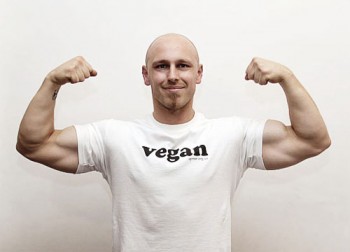
Dave glances at my plate of spinach, beans, and brown rice as I eye the meatballs Not me... yetnestled in his spaghetti.

“You eat like a rabbit,” he says.

“Rabbits don’t generally eat garbanzo beans or cooked rice,” I reply.

“But still…”

As the conversation changes, he forgets my rabbit food, and I forget his meat. In the end, it doesn’t really matter what we have.

According to a 2008 study by Harris Interactive Service, about 7.3 million people are vegetarian in the United States—that’s about 3.2 percent of the population. Most are young, from middleclass backgrounds, and live in the Western or Southern regions of the United States. I’m one of them, a skinny, grain-eating, tofu-crunching middle-class American.

Nothing radical there.

We vegetarians eat about three meals per day—just like our omnivorous counterparts. We don’t all use organic paper and beet-juice ink or attend regular services at hippy churches on weekends.  Most aren’t PETA extremists who throw red paint at fur coats and survive on seaweed and unpronounceable grains. Perhaps our farts smell a little bad sometimes, or we’re be a pain to take out to dinner, but most of us are pretty normal. At least I think so.

Still, some people berate me with things like, “why the hell would you do that?” or “we deserve to eat animals,” or my personal favorite, “you’re going to die because you’re not getting enough protein.”

Others aren’t so malicious. They just don’t understand, or grow up thinking that all vegetarians fit the same model. But we are all very different and have very different reasons for becoming vegetarian.

Continue reading “Making the Switch”

Aphorisms

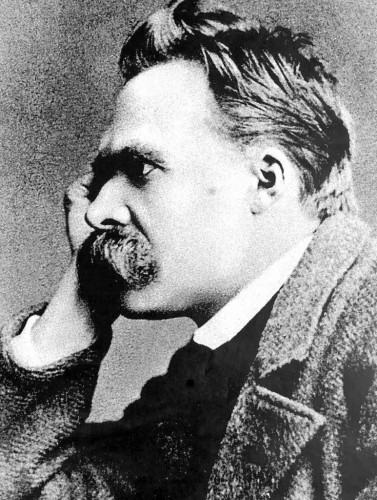
Call this a sequel to my last post. I graduated yesterday, and have been busy moving, nietzsche-377x500unpacking, and processing my final weeks. So I haven’t had much time to research or write anything new.

Still, in the midst of it, I’ve been reading Nietzsche. Along with his break with Wagner in 1876, Nietzsche took leave from his post at the University of Basel. With his freedom, Nietzsche wrote a series of aphoristic works, beginning with Human, All too Human and ending with The Gay Science.

I just finished reading excerpts from the set of them.

Before these works, Nietzsche wrote essays or reflections, The Birth of Tragedy being the main example. After, his work retained this aphoristic bent, even when he resumed a more traditional essay style, as in Beyond Good and Evil. The style may owe much to the German philosopher Schopenhauer and the French tradition that predated Nietzsche, which influenced his work a great deal, but he made it his own with his sharp wit, dynamic language, and unique philosophy.

Influenced by Nietzsche, I figured I’d share a few aphorisms I’ve gathered during college. I’ve heard some, borrowed others from books, and made up a number. In no particular order, here are a few:

Continue reading “Aphorisms”

Kant and Camus: The is and the ought

Last year I was reading the giving The Giving Tree by Shel Silverstein to my nephew,

German Philosopher Immanuel Kant (1724-1804)

around five at the time. In the book, a tree sacrifices everything for a particular boy who gradually grows into into an old man. First simple things, like leaves, but by the conclusion, the tree is a stump with nothing left to give.

I closed the book, just like my dad did when I was a kid. “Believe it or not,” I said. Henry snuggled next to me with Eddy the Elephant and closed his eyes. The house was quiet, his brothers asleep in bed, his parents downstairs. Then, in the most innocent voice—as if he were asking for a cookie—he asked, “Why do people die?”

“I don’t know,” I said. It hurt to say it, but I couldn’t lie.

And I don’t think I’ll ever know. I may be able to craft a very elegant “I don’t know,” but in the end, that’s all it will be.

Continue reading “Kant and Camus: The is and the ought”