Dreyfus and Magee: Phenonomology and Existentialism

This week, I’ve been watching these 1980s videos with BBC host, author, and thinker Bryan Magee.

Each one is five parts, coming in at about 45 minutes, and is a great watch. Magee does a good job putting difficult concepts into fairly ordinary language and summarizing things.

I’ve uploaded one on phenomenology and existential philosophy, although most of it deals with Heidegger.

All of the videos are good. You get to see articulate, intelligent people discuss dynamic topics with extremely tallow-colored backgrounds! (What could be better than that?)Enjoy!

Maps

So I am neither dead nor lost in some Tron-like universe, detached from reality. I’m treasure_map__skull_island_by_pumpkinjack6-d30me8qjust very busy: a starring role in a musical, an honors thesis, and the day-to-day tasks of tutoring and studying. Still, I apologize for my absence.

That said, I don’t have anything new today. But I figured I could copy-and-paste part of my honor’s project, a memoir that also involves French writer Albert Camus called Coming of Age with Camus. It’s coming along, but still needs work. Call it a peace offering.

Here’s the first chapter, Maps:

Continue reading “Maps”

Kant and Camus: The is and the ought

Last year I was reading the giving The Giving Tree by Shel Silverstein to my nephew,

German Philosopher Immanuel Kant (1724-1804)

around five at the time. In the book, a tree sacrifices everything for a particular boy who gradually grows into into an old man. First simple things, like leaves, but by the conclusion, the tree is a stump with nothing left to give.

I closed the book, just like my dad did when I was a kid. “Believe it or not,” I said. Henry snuggled next to me with Eddy the Elephant and closed his eyes. The house was quiet, his brothers asleep in bed, his parents downstairs. Then, in the most innocent voice—as if he were asking for a cookie—he asked, “Why do people die?”

“I don’t know,” I said. It hurt to say it, but I couldn’t lie.

And I don’t think I’ll ever know. I may be able to craft a very elegant “I don’t know,” but in the end, that’s all it will be.

Continue reading “Kant and Camus: The is and the ought”

Labels

Labels are insidious. I imagine them slipping around like lampreys and aphids, Sticky_note_sleepingnotching their toothless jaws to us. They slip into conversation, into thought, and spatter the world like sticky notes, categorizing, separating, allocating, and organizing. We can pry them loose, but they always seem to slip back and latch on again. They’re often at the foundation of how we operate, whether we’re aware of them or not.

One of my favorite–albeit “sketchy”–pastimes is to sit in a crowded place, especially on a college campus, and look at how people naturally sort themselves, fitting into tidy categories

The “jocks,” with short, blond hair, fit physiques, and exercise clothes sit together. So does the alternative crowd, people like “hipsters,” with quirky sweaters, weathered jeans, and sunglasses, or the lingering pockets of “goth” and “emo”culture.

The pre-med students group together, and the theater folk unite. The church-going flock together, filling the same long tables at meals with persistent regularity.

People separate and and sort by age, majors, music tastes, geographic locations– anything to segment and define–and looking at them, I, too, block people together under labels.

I often wonder where the label ends and the person begins.

Continue reading “Labels”

Own it: Authenticity

Rain clouds loomed outside as I sat across from my spiritual advisor, Br. Robert, in the simple room. “You have to own it,” he said. “You’re an artist. Own it.”

He talked about his early years as a friar. The other friars didn’t think much of his penchant for painting, forcing Br. Robert to sacrifice his own time, money, and space for it. At one point, he even tried to suppress the urge because it interfered so much with his religious duties. Just as Thomas Merton complained about his “double” as a writer pestering him during his early years with the Trappists, Br. Robert struggled with the artist fighting for expression from within.

When he left the friars–and the Catholic Church for a time–Brother Robert lived on Skid Row, trying to make his work as an artist. He found a deep, resonant calling. Surviving on rice and beans–tuna fish, when he could afford it–he scraped by, but his art taught him his vows better than his stint with the friars. Poverty. Obedience. Chastity. The words clarified as the years wore on.

For Br. Robert, devotion to art proved a devotion to God.

“Own it,” he had said. The words made sense as he said them, but didn’t resonate. As the years has pass, the words Br. Robert and I shared deepen and clarify, like his vows. Tempered and stretched by experience, his wisdom grows. I understand him now.

Continue reading “Own it: Authenticity”

Reflections in an empty cafe

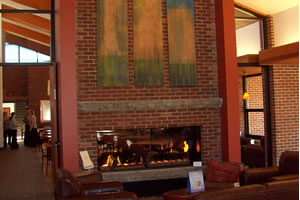
Okay, so the cafe isn’t quite empty. It’s got a few green-shirted workers sweeping the

Cafe La Verna, as pictured on St. Bonaventure’s site.

floor and standing around balancing on their heels. But it’s almost empty.

A gray drizzle shadows the campus outside and a warm fire flickers nearby, giving the illusion of warmth. Most of the students have left for break or are elbow-deep in packing. I’m staying to work and reflect. It’s been a busy few weeks and I need to catch my breath, write my thesis, and sort out my post-graduation life.

A few thoughts swirl in my head. Last fall, I sat in this same cafe for 12 hours. It’s a campus-bound Starbucks with earthy colors and cozy chairs called La Verna, a place where time slips away unnoticed and people pass through like birds in migration. Grounded there for so long, I felt like a rock watching the seasons change.

Continue reading “Reflections in an empty cafe”

Kafka Quote

“We are as forlorn as children lost in the woods. When you stand in front of me and look at me, what do you know of the griefs that are in me and what do I know of yours. And if I were to cast myself down before you and weep and tell you, what more would you know about me than you know about Hell when someone tells you it is hot and dreadful? For that reason alone we human beings ought to stand before one another as reverently, as reflectively, as lovingly, as we would before the entrance to Hell.”

Franz Kafka in a letter to Oskar Pollak