Reflections in an empty cafe

Okay, so the cafe isn’t quite empty. It’s got a few green-shirted workers sweeping the
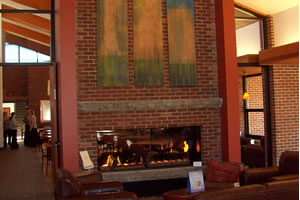
Cafe La Verna, as pictured on St. Bonaventure’s site.

floor and standing around balancing on their heels. But it’s almost empty.

A gray drizzle shadows the campus outside and a warm fire flickers nearby, giving the illusion of warmth. Most of the students have left for break or are elbow-deep in packing. I’m staying to work and reflect. It’s been a busy few weeks and I need to catch my breath, write my thesis, and sort out my post-graduation life.

A few thoughts swirl in my head. Last fall, I sat in this same cafe for 12 hours. It’s a campus-bound Starbucks with earthy colors and cozy chairs called La Verna, a place where time slips away unnoticed and people pass through like birds in migration. Grounded there for so long, I felt like a rock watching the seasons change.

Continue reading “Reflections in an empty cafe”

Stars and Broken Seashells

I haven’t posted in a while. I apologize. Life has a nasty way of putting things we enjoy doing to the edge of our days. But, in any case…

Raindrops slapped the tinted leaves and rolled onto the path, now dyed black by moisture. I kept my hood down, sheltered by leaves, and took in the ruddy hills and open fields, the trees around me sighing with the weight of rain.

The air was wet and subdued, while a rumpled gray spanned the sky, tucked into the horizon like an old blanket. I could feel things slowing down, fall coming, a dimming twilight before winter, the air changing.

I started talking Sunday walks–once per week–after I stopped going to church last fall. The empty ritual and hollow chants didn’t nourish me. I figured a walk in the woods held promise, unbound by the time-soaked labels of the Latin Rite and the Christian cannon.

Even if I didn’t call it God, something in nature holds the same transcendent immanence for me–even if it’s just an illusion of experience. It’s something I can cling to and feel cradled in.

I also use my walk as a time to think. Today was no exception.

Continue reading “Stars and Broken Seashells”

Echoes and identity

I’ve been reading Camus’ preface to Jean Grenier’s The Islands, published in 1959. Like much of Camus’ later work–he died Jan. 4, 1960–the preface is nostalgic, yet mature.

The Allegheny River Trail at dusk, taken by me.

Grenier’s book proved a major influence on Camus as a young man. In return, Camus dedicated his first collection of essays The Wrong Side and the Right Side and The Rebel to Grenier.

In the preface, Camus describes how he felt when he first started reading Grenier’s The Islands:

A garden of incomparable wealth was finally opening up to me; I had just discovered art. Something, someone was stirring dimly within me, longing to speak. Reading one book, hearing one conversation, can provoke this rebirth in a young person. One sentence stands out from the open book, one word still vibrates in the room [. . .] Already, at the same moment, in response to this perfect language, a timid, clumsier song rises from the darkness of our being.

Reading The Islands pushed Camus to be a writer. Other books aided the decision, but as Camus says in his preface, only The Islands lingered. It transformed his worldview, and he continued to quote it for the rest of his life, repeating the phrases as if they were his own.

There are moments, words, people that define who we are, that consume us like kindling in a violent flash. From there, we rebuild on a new foundation. But the fire never burns down. It continues to smolder.

Continue reading “Echoes and identity”

Fleeting and Eternal

I often sit and stare at the sky, watching the clouds drift and dissolve in silence. Bugs

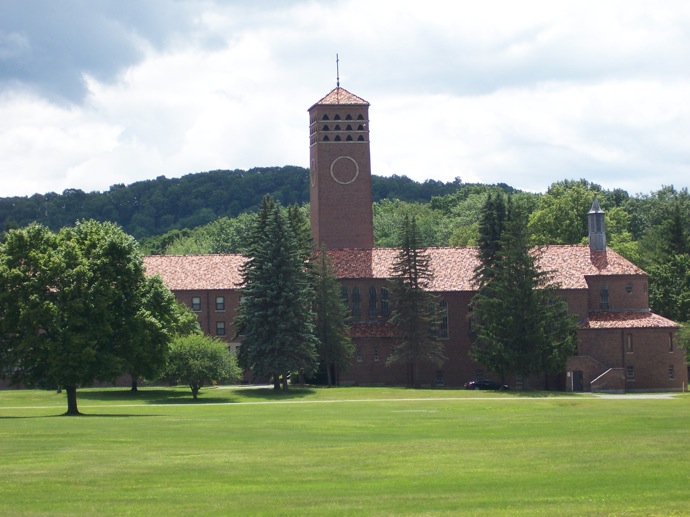
Picture of St. Francis Hall, St. Bonaventure. Taken by me.

furrow through the grass. Pools of shadow sift light. Branches murmur in the wind. Now and then, people cross on sidewalks, their soft strides pacing conversations as they pass away. Sometimes they wave.

Right now, I’m doing the same: sitting under my favorite tree on campus, looking at the brick buildings strapped to the ground, the drunken sky a whirl of cirrus and cumulous flooding the blue above.  It’s summer and the quad is quiet and still–almost deserted. The buildings slumber, their windows dark, their doors closed.

Normally I feel lonesome in the slow trickle of strangers and the empty hours before me. I do today. But something deeper always opens in such moments, as if it requires the sun-laced stillness of an empty afternoon.

Continue reading “Fleeting and Eternal”

The nearness of the distant

I’ve done a bad job updating this blog so far, so I’m going for a shift of focus: I’m going to make it more personal. I apologize for the gaps in posts so far. Scouts honor–and I was a Boy Scout–I’m going to post more regularly from now on. So to get to business…

I’m nearing my final weeks of junior year. Clouds cover the sky like a rumpled old blanket, sapping color from the St. Bonaventure campus. I imagine Heidegger walking by the nearby river on such days, his steel gray hair matching the clouds, his footsteps lagging as a new thought turns over in his head. He was a heavy guy. Even his name. Heidegger.

I’m writing a paper, drawing from an essay he wrote: “Who is Zarathurstra?” He analyzes the unity he sees between Nietzsche’s concepts of “overman” and “eternal recurrence,” doctrines threaded through Nietzsche’s works. The ideas are heavy, sunken cathedrals built on traditions of metaphysics dating back to Plato.

Through the dry but brilliant essay, a line stands out: “Longing is the agony of the nearness of the distant.”

Sometimes philosophy has poetry wedged between the arguments; the line captures my mood during these final weeks.

Continue reading “The nearness of the distant”

Backyard Philosophy

This is a blog about “backyard philosophy,” a name I made up one day in the shower. But I confess I stole it from Aristotle. Adrift in the boundless arguments and counter-arguments in his Metaphysics, I found a passage about philosophy’s humble birth. From its words, I’ve crafted my worldview and bound up my hopes. Although it’s a bit dense, I want to copy the complete passage here:

That it is not a productive science is clear from a consideration of the first philosophers. It is through wonder that men now begin and originally began to philosophize; wondering in the first place at obvious perplexities, and then by gradual progression raising questions about the greater matters too, e.g. about the changes of the moon and of the sun, or about the stars and about the origin of the universe. Now, he who wonders and is perplexed feels that he is ignorant (thus, the myth-lover is in a sense a philosopher, since myths are composed of wonders); therefore it was to escape ignorance that men studied philosophy, it is obvious that they pursued science for the sake of knowledge and not for any practical utility. (Metaphysics, Book I, part  2).

I read these words with a hushed sense of awe because they immediately brought me back to my early adolescence. Sitting beneath a broad canopy of stars in my backyard, my friends and I talked. And between the intervals about girls and school-wide politics, we hit deeper questions. They were still limited, but we stumbled through speculation on God or purpose in our lives, why we do things we do, our identity to ourselves and the world. Personal and simple, the issues nevertheless had the same philosophical underpinning that span Plato’s dialogues and Camus’ novels.

Continue reading “Backyard Philosophy”