On Frasier and Leaving The Past Behind

I’ve been watching a lot of Frasier the last few weeks. Maybe it’s a hankering for something funnier than today’s formulaic television comedies, or it’s probably just that the show is wickedly entertaining.

from fanpop.com
from fanpop.com

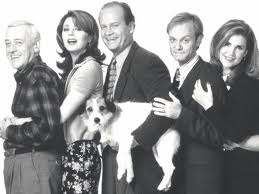
The 90s powerhouse comedy features Kelsey Grammer as the titular Dr. Frasier Crane,a pseudo-intellectual radio psychiatrist trying to get through life despite his multiple character flaws. He’s joined by his equally pseudo-intellectual psychiatrist brother Niles, his retired cop father and his snarky British housekeeper as he weaves through a series of unfortunate shenanigans.

In the episode “Seat of Power,” the Crane brothers attempt to fix a leaky toilet to prove to their father they can do more than recite Faulkner and wax poetic on a particularly good vintage. Of course, they fail miserably and call in a plumber; in a twist, the plumber is one of Niles’s high-school tormentors.

Niles wants no more than to shove his foe’s head into the toilet, giving him a “swirly,” the torture he endured many time in high school. Frasier talks him out of it, instead urging him to tout his success: the “living well” revenge.

When that backfires (the plumber drives a Mercedes and has a fulfilling marriage), Frasier recommends Niles simply talk it out with the bully. Though Frasier ignores his own advice when he takes a toilet-water infused revenge on a second bully-turned-plumber, Niles comes to terms with his aggressor and moves forward, settling some 20 years of pent-up anger.

You may wonder what my point is, but I was struck with how well Niles and Frasier’s misadventure mirrored my own struggles with leaving high school resentments behind.

Continue reading “On Frasier and Leaving The Past Behind”

Starlight and renewal

Sometimes, when I’m tired or lost I look at old writing. It reminds me where I camestars1.jpg from, what has always mattered, and where I ought to go. Today, as I struggled to write a blog post, I sorted through old files and notebooks.

I found this, a reflection from fall of my junior year. It was a hard semester, as I’ve referenced before, but it many ways, it set my foundation. In the midst of that darkness, I found my passions and insecurities. I found my self.

I think this particular reflection captures a lot of that. It also hits at the seed that inspired this entire blog: the fusion of life and philosophy that makes “backyard philosophy.”

I repost it in full below, only edited for grammar. We all need reminders now and then.

Continue reading “Starlight and renewal”

The Quest for Peace

Something I wrote before: “I am not like yesterday. Not yet tomorrow. I am today.” This line returns to me like a long slow breath, stretching syllables until they share the weight of my body and soul.   And then I remember what I lack, what I fear, what I need for “today” to be here with me as my present self. Because tomorrow I will say, “I am not like yesterday.” Thoughts are my enemies, but I learned that peace is something that never ceases to exist. It’s there. But peace is humble; it doesn’t seek our attention. In lieu, we must be the ones to pursue it—or perhaps, realize peace.

The quest for peace in our days is a labyrinth with its dark tunnels and hidden passageways. I am in this maze just as much as you are.  But I have discovered that the peace is the maze itself. Or maybe not? Well, I am still living and learning. Ten or twenty years from now I might assemble a different perspective on peace. But, as of now, I am taking a stop in my travels, so I can let my life stir what it has collected over the years.

Within the stream of my thoughts and endless needs and desires, I can feel the weight of the world dropping on my hands like tiny seeds waiting to be planted in my head. And within my fears and doubts, I can distinguish which seeds I had actually considered to plant ten years ago.

I am not drawn to gardening at all, but if I had the influence, I would. As of now, I am tending the garden in my head and, especially, my heart.

Peace grows where we unite ourselves to the soul of peace.

I don’t want to say the ground of peace or the core of peace, but rather the soul—the soul is its life, its true breath. The soul is an intimate substance. It is where the encounter of our essence and intangibility gaze at each other as lovers do before they depart. The only difference is that the makeup of our soul never leaves—it is us. And we make that precious encounter with peace when we contemplate on its authenticity as opposed to the benefits or outcomes of peace itself. In a similar way, we make that distinctive encounter with ourselves when we contemplate on the intimate reality that we possess in our souls. Not in yesterday’s reasons and excuses or tomorrow’s goals and desires, but today’s moment. Peace is for today; it’s meant for today. And it’s meant for us and it longs for each of our distinctive union.

As I have mentioned before, peace is humble, so it is not ignorant or oblivious to its own beauty and power. As each fear or troubling thought marks its territory in my mind, peace remains quiet and patient because it knows I have to make the effort to enter into its sanctuary.

We must humble ourselves to encounter peace. We must admit our faults and frustrations and realize that there are things in life we do not have control over. Deep inside ourselves, we are vulnerable and powerless. Deep inside ourselves, we fail to remember our human quality which is truly vital to recognize as we face our struggles and disappointments. But, we, most importantly, overlook the active presence of our soul that is oftentimes deadened by our fleeting pursuits of unnecessary and damaging ambitions. And, yet, peace still waits for us. Underneath, above, in between our angst and fears and concerns—peace is there. It exists. It exists. It exists.

Empty blue mattresses

June 24, 2011. Blue and white caps and gowns dotted the football field. From my chair in the front row, I remember thinking to myself, “I will never be in the presence of this exact group of people ever again.” 

Since then, I can count on one hand how many people from my high school graduating class I’ve gone out of my way to see since that June evening over two years ago (the answer is three –– not kidding).

But my lack of friends from high school is an entirely different matter; the real point here is that there are moments we seriously can never get back. And places, too. Physical locations are just as important.

Polka-dots galore, welcome to my freshman dorm room.

I adored my freshman year dorm room. I have so many memories trapped within the walls of room 157 in Loughlen Hall. My friends and I watched Jenna Marbles videos and snuggled in my bed. We got fancy with wine the night before one of my finals and shoveled handfuls of classy taco cheese down our throats, the next-best thing to Gruyère.

It hits me when I remember that room doesn’t exist anymore. And some of those people in the memories don’t even attend the university now. We’ll never recreate that group of people or the place we once called “home.” The then-polka-dotted walls are back to their original white cinder-block state, with lonely bed frames housing empty blue mattresses.

I’m currently in limbo, picturing my dorm room from this past year instead of looking forward to a new white box to call my home. And what I’m thinking of and picturing doesn’t even really exist anymore. The frame does, the touches that made it Emily’s Room don’t.

Next time you’re in a group of friends, look around. Memorize facial expressions and laughter. Take the time to discover what each person contributes to the gathering and ponder what it would be like if he/she were not there. How do your surroundings make an impact? What if you could never return to that particular place? You’re living in a moment that may never present itself again. Cherish it.

I hope that if/when my parents sell my childhood home, the new owners take the time to look it over and imagine bare feet tearing through the different rooms and up the staircase. I know I will be.

The minute that “SOLD” sign is posted, I’ll have lost access to a portal containing countless memories; one that can never be reopened once sealed.

Carl Sagan

I’m a bit of a Carl Sagan junkie. I suppose it started the evening before Thanksgiving Carl_Sagan_Planetary_Societybreak my junior year, when my ride changed plans to leave the next morning. With an evening free, I scanned HULU for a show to kill time with. It recommended Cosmos, and after reading the glowing comments, I decided to check it out.

The name Carl Sagan was familiar, and I had seen his parted hair, turtleneck, and beige jacket parodied on television. I had also heard his famous Pale Blue Dot monologue at a talk from Bill Nye, who respected Sagan. I even met a professor from Cornell who got his office, replete with a hidden foot pedal to call campus police for unwanted visitors.

But the pieces didn’t connect.

The strangely nostalgic piano and synth-string theme played over an intro of star fields and passing nebula. The café around me softened into a whimpering white noise of scuffing tables, chatting workers, and clattering cups. Sagan spoke, his iconic cadences seeming to pick out words with the precision of tweezers.

“The sky calls to us,” he said. “If we do not destroy ourselves, we will one day venture to the stars.”

Continue reading “Carl Sagan”

Option overload

Standing in the tea aisle of my local Wegmans, my heart pounded and my head froze. Too many choicesThe prim, brightly colored canisters and shiny, cellophaned boxes stared at me, rows of them, emblazoned with brand names, alleged health benefits, and flavors. Some were fair trade, some were organic. Others were just cheap.

I didn’t know what to do.

In the end, I picked a compromise of price and quality. The anxiety seems crazy. And, as my dad quipped when I mentioned the issue, it’s better to have too many choices than none at all. True. But option overload has become an increased problem in the West.

As absurd as it sounds, too many choices can be a bad thing.

Continue reading “Option overload”

Thoughts on friendship

Tonight, I go on my fifth annual road trip with a few high school friends. The six of us

From the Painting "Kindred Spirits."
From the Painting “Kindred Spirits.”

met in seventh and eighth grade making films. Now and for the past four years we’ve been going in separate places: different schools, different interests, different cities–even states.

Still, something has held us  together, for the past eight years. Sometimes, that’s hard to believe.

Dunbar’s number dictates we can only keep track of around 150 beings at any given time. If they’re too distant, they don’t make the cut and blur behind a thin haze of anonymity.

During our lives, few people make the cut. Those who do so consistently become friends.

Friendship has the rare honor of being part of “the human condition,” the seemingly universal and timeless experience that defines what it means to be human. I don’t know if anyone has ever tried to outline our condition, but I imagine that friendship would be on the list somewhere.

Despite it’s prevalence, however, friendship remains a brittle obscure topic. As Thoreau opens in his essay Friendship, “Friendship is evanescent in every man’s experience, and remembered like neat lightening in past summers.” It takes place for all of us, sometimes for just a fragile collection of moments. Yet we can barely describe what makes it so essential.

Continue reading “Thoughts on friendship”

Back home

I’ve been home for about three days now after surviving over 24 hours traveling, sustained by Cliff Bars, airline food, and caffeine. My mom barely held her tears in as she squeezed me near the baggage counter in the echoing spaces of the near-empty airport. The rest of the flight pooled around the carousel, frayed and wrinkled.

“It’s good to be home,” I said.

And it was. Four days before, June 30th arrived after weeks of warnings, anticipation, and scattered protests. Like a ruptured pipe, millions pooled into the squares and streets across Egypt. Tamarod, the grass-roots movement that organized the opposition, flaunted 22 million signatures to throw out Morsi while Tagarod, the pro-Morsi opposition, organized sit-ins.

As some graffiti said, “January 25 and June 30, our Revolution continues.”

Flags, fireworks, clenched fists, posters, and red cards colored the crowds. Couples, children, and friends held cards reading “Leave.” In a country with notorious disregard for timeliness, organization, and teamwork, millions gathered with a single purpose.

“It is the biggest protest in Egypt’s history,” one official told Agence France-Presse.

Continue reading “Back home”

Egypt, Week Two

The setting sun tints the Cairo train station like a sepia-toned photograph as we pull away. Through the smudged train window I watch an old man in a frayed linen jacket search through his old army bag as he leans against a smog-stained pillar. Friends take photographs in front of low concrete benches, and a woman hoists a bag of rice on her head, trailing her three children behind.

The train gains speed as Cairo’s unfinished block housing gradually gives way to broad fields, dotted with a few workers: the Egyptian countryside. Between the fields stand buildings like unfinished shelves, piled and cramped together, with the rebar poking out like lose whiskers.

Dea, Micheal, and I are on our way to Alexandria, Alexander the Great’s famous capital, where Cleopatra once saw Mark Antony and Eratosthenes invented modern geography over 2,000 years ago.

I’ve wanted to see Alexandria since I was a child. The Lighthouse and the Library represent one of the peaks of human civilization, and some of history’s greatest thinkers walked in their shadows. 

Mindful of Alexandria’s epic history, I also recall Egypt’s current issues. The unemployment rate remains over 13%, tourism declines, and the Egyptian pound continues to fall. Rebels block roads around Cairo, intercepting commuters to deliver political statements. Hard-line Salafis attack shrines for Sufi mystics. A recent hotel on the Red Sea celebrated its opening by smashing alcohol bottles on camera. Basic necessities, like bread, fuel, and electricity, remain threatened. Crime is at an all-time high…

Things do not look good for Egypt.

All this occurs as Morsi wrestles to assert Egypt’s water rights against the Renaissance Dam that the Ethiopian parliament voted unanimously to build last week. He cut ties with Syria’s Assad, spurring controversy, and he picked a man named Adel Mohammed Al-Khayat with alleged ties to a terrorist group responsible for an attack that killed 58 tourists last Nov. 1997. Egypt’s tourist minister resigned from the appointment.

Things do not look good for Morsi.

I think of what one student told me the night before. “Before the revolution, we did not have freedom, but we had safety. Now, we have freedom, but no safety. Soon, we won’t have freedom either.”

His words capture the sentiment of many Egyptians. A recent poll by the Arab American Institute puts Morsi supporters at 28 percent–and falling.

A group named Tamarad, “Rebel” in Arabic, hopes to capitalize on this discontent for Jun. 30 demonstrations. Each day, Tamarad gains support: politicians, like Mohamed El-Baradie; disillusioned youth; lawyers; writers; and everyday workers ousted from a job.

Tamarad has already gotten over 13 million signatures for a petition to cut short Morsi’s term and have a new election–almost 15 percent of Egypt’s population.

And things do not look good for tourism. As my time here continues, I consider that this may be my last time in Egypt, at least for a long time. Travel cannot flourish in a broken, unsafe region.

My thoughts swirl as I watch the sun–a bright orange bead on the horizon–set. The train rattles; food carts and hawkers come and go as they sell humus, tea, and sesame treats. Smokestacks silhouetted against the sky smolder like snuffed candles. The fields of sugarcane pass by until they’re too dark to see.

Sometimes at such moments, something opens up inside me: all my years collide into a single moment. One of my friend calls it “the abyss opening up.” I can’t explain it. I can only feel it.

I wonder how I got here. Looking back at my life, I remember when I tried learning hieroglyphics in ninth grade. Around the same time,  I made my own Rosetta stone from wet clay. I also collected papyrus scrolls from novelty shops, pouring over them with a magnifying glass.

Freshmen year in college, I took an Islamic art course and witnessed a new world of geometry and arabesque opening up, embedded with traditions recited hundreds of years ago: the alleged dictations of God. 

One by one, the moments gather, as Beckett’s characters say in Endgames: “Grain upon grain, one by one, and one day, suddenly, there’s a heap, a little heap, the impossible heap.” After years of disjointed hours you’re on a train bound for Alexandria and can’t explain why.

I suppose the same could be said for Egypt. One by one, the eons accrue, layered like scar tissue as time ticks forward. Some problems never leave. New ones arise. The people live on. Then, one day, you have an “impossible heap” of problems. Someone must take stock and unravel it, but it’s to big and convoluted to make any sense.

Writing in my notebook, thinking of Egypt, and trying to pin down how I feel, the train rolls on.

***

The next day, we begin our tour, wary after a taxi driver tried to overcharge us the night before. John, a quiet guide with a goatee and a Coptic cross on his wrist greets us in the hotel lobby. After a small stop at the august Opera House, we reach our first major site: the Kom al-Shoqafa, catacombs started in the second century AD. Lost for hundreds of years, a citizen found them in 1900 after his donkey broke through the ground.

We descend a spiral staircase where people once carried the dead bodies to be buried. At the bottom, we enter a low low space that smells of wet clay. Marks of picks and chisels etch the limestone walls, feathered and numerous, like snow disturbed by wind.

The guide points out the mingling of Greek, Egyptian, and Roman symbolism that fills the tomb. In one corner, Anubis wears a Roman centurion uniform. In another, Greek garlands surround scenes with Isis and Ra. The site began as a tomb for a rich family, but gradually expanded into a public cemetery that housed over 300 bodies.

I picture the workers carving the stone, the families hoisting the dead through tunnels, and the mourners grieving in thin beams of light.

Next, we visit to the National Museum. Built in 2003, the museum is an air-conditioned collection of history from Egypt’s Old Kingdom, over 6,000 years ago, to the present day. We pass mummies, statues, and mottled ruins hoisted from the harbor from the time of the Light House and the Library over 2,200 years ago.

Used to a country born in the late 1700s, a 6,000-year-old statue of a scribe is impossible to really comprehend.

We end our tour with the Library, a vast modern structure designed to incorporate ancient design elements–like the lotus flower–with modern materials and a modern aesthetic. A 32-meter-high glass-paneled roof rises from a broad reflecting pool. It’s meant to mimic the sun rising from the sea. The walls are of gray Aswan granite, etched with characters from 120 different human scripts.

Inside, the library hosts museums and a sprawling reading room with millions of books in multiple languages. The library also has millions of ebooks, always gathering more.

It’s a beautiful space, and the library guide–a well dressed women with the voice of a recording–rattles off stirring statistics. Still, I wonder what Egypt’s impoverished population can do with a $220 million dollar project that costs students alone 30 pounds for a year-long subscription.

After the library, we eat lunch at the Fish Market, a popular restaurant where you pick your meal from a display of fish on ice, eating it alongside Mezze and fresh-baked bread. The guide calls his mother and asks her how she makes pickled lemons.

After this, we split up. Dea continues on the tour, while Michael and I opt to walk along the shore. Away from the touristy Fish Market–with its clean tables and gentle piano music–a new world surfaces.

Children run into the water, liberated from thin beaches packed inch-by-inch with folding chairs. An old woman swaddled in black veils works at a public wire to steal electricity. Cabbies and buggies stop along the sidewalk, calling us.

“Welcome to Egypt! You want ride? Very, very cheap!” they say, as if on repeat.

The stench of garbage mingles with the smell of sea water, but farther out, the water is surprisingly crisp and blue, with fishing ships flashing in the sun as they bob. Bright flags ripple with the steady wind. Cars honk alongside us like a pack of dogs. On rocky shorelines beyond the beach, people try to catch fish with long, tapered poles.

On our way back to the hotel, we pass a boy trying to fly a piece of paper attached to a string. He isn’t having much luck, so Michael takes apart a nearby basket and fits two sticks in a cross-like pattern on the paper.

“Kite!” the boy says.

We exchange mutual smiles and continue.

Nearby, we pass through a kids’ carnival outside of a mosque. Two young boys race down a hill on ramshackle scooters, almost running over Michael and I.

“Habibii akbar!” one screams, “my great beloved!” He banks left to avoid a crash, knees tucked up to his sholdiers.

After about two hours, we reach the hotel. Dea meets us there. We go out to eat at the palatial Four Seasons–including a bottle of wine. After that, we visit some of the shops of cheap shoes and misspelled T-shirts with things like “Honeymoon Nightmare [incompresnsible word]” airbrushed on in distressed letters. The crowd of young people surges around us, scoping out bargains and enjoying the cool air.

The next day, we leave the hotel and  find our train in the maze of the Alexandria station. The station master tells us one platform, then a passenger yells out another as his train carries him away. The passenger is the right one.

On the bleached old train again, hearing the door clatter as people use the bathroom and vendors race along the aisle, I look out the window. I got what I came for: a taste of a city I’ve always wanted to visit. I also got to visit the ocean that Camus loved so much, walking among the packed beaches, drenched in noonday sun. I could almost see a young Camus among the other children, kicking the soccer ball or swimming through the water, his strong arms cutting through the pale blue.

Phrases of his writing circled in my head the whole trip.

Returning to Cairo, I understand better why he loved the sunlight and the sea–the “wealth of poverty” as he sometimes called it. I guess that was another grain that piled up, spurring my trip.

With all the echoes of past years following me through the city I felt like I was on some pilgrimage. It was just a feeling, but I couldn’t ignore it.

Perhaps, like Chaucer’s pilgrims, we endure the road because we have something sacred at the end of it. Not something religious, but a dream we’ve always wanted to flourish or a place we’ve always wanted to see. The images of a photograph or the words of a particular writer in our younger years become myth-like, and we long to visit their source, like Dorothy longing for “someplace over the rainbow.” Such places feel like they can’t exist in real life. They’re too magical.

But they do.

Whenever I talk about Egypt, people always tell me that they can’t imagine seeing the Pyramids. One can’t. They feel like dragons plopped in the midst of everyday life, something remarkable transcending the mundane.

Alexandria was similar. The name itself evokes hundreds of fantasies and has for thousands of years, culling travelers from all over the world. I feel blessed that I was able to hear its siren song, endure the road, and reach it. I won’t forget what I saw or what I felt. And I hope that other travelers–kids who collected papyrus, read Camus, or pursued their own passions–set foot on their own pilgrimages and that their holy sites remain intact and beautiful.