Yep, another update. But I should be having some more substantial posts soon as I only have four more weeks of school before winter break. In the meantime, the work goes on. Still, I have some reflections to consider.
“You have to do what nourishes you,” one of my English professors said earlier this semester. The words have been close at hand the past few days. After a three-week low, I’ve started to pick up lately. I’ve gotten a lot of work done and have had some meaningful interactions with people.
I’ve been thinking a lot lately, going over old photographs and reading articles. It’s been introspective. At such times, I always recall an image a friar once used to describe spiritual growth: Augustine’s wineskins.
Augustine noted that a fresh wineskin is too tight to hold much wine. Someone fills it, and it strains, bulging and stretching, ready to burst. Gradually, it stretches enough to hold more, so we pour more in, but again, it fills quickly. Still, it stretches, and as we repeat the process, it can suddenly hold gallons.
Likewise, life stretches us through challenge, reflection, and experience. The same events that hurt us or stretch us as we grow, let us hold more. As another friar told me, “The older I get the more grief I can hold.”
Rain clouds loomed outside as I sat across from my spiritual advisor, Br. Robert, in the simple room. “You have to own it,” he said. “You’re an artist. Own it.”
He talked about his early years as a friar. The other friars didn’t think much of his penchant for painting, forcing Br. Robert to sacrifice his own time, money, and space for it. At one point, he even tried to suppress the urge because it interfered so much with his religious duties. Just as Thomas Merton complained about his “double” as a writer pestering him during his early years with the Trappists, Br. Robert struggled with the artist fighting for expression from within.
When he left the friars–and the Catholic Church for a time–Brother Robert lived on Skid Row, trying to make his work as an artist. He found a deep, resonant calling. Surviving on rice and beans–tuna fish, when he could afford it–he scraped by, but his art taught him his vows better than his stint with the friars. Poverty. Obedience. Chastity. The words clarified as the years wore on.
For Br. Robert, devotion to art proved a devotion to God.
“Own it,” he had said. The words made sense as he said them, but didn’t resonate. As the years has pass, the words Br. Robert and I shared deepen and clarify, like his vows. Tempered and stretched by experience, his wisdom grows. I understand him now.
Some advice from my favorite Stoic, Marcus Aurelius, that I ran across today:
“Live a good life. If there are gods and they are just, then they will not care how devout you have been, but will welcome you based on the virtues you have lived by. If there are gods, but unjust, then you should not want to worship them. If there are no gods, then you will be gone, but will have lived a noble life that will live on in the memories of your loved ones.”
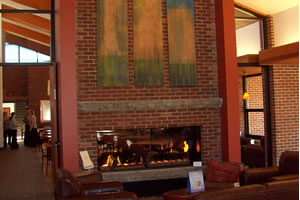
Okay, so the cafe isn’t quite empty. It’s got a few green-shirted workers sweeping the
Cafe La Verna, as pictured on St. Bonaventure’s site.
floor and standing around balancing on their heels. But it’s almost empty.
A gray drizzle shadows the campus outside and a warm fire flickers nearby, giving the illusion of warmth.Most of the students have left for break or are elbow-deep in packing. I’m staying to work and reflect. It’s been a busy few weeks and I need to catch my breath, write my thesis, and sort out my post-graduation life.
A few thoughts swirl in my head. Last fall, I sat in this same cafe for 12 hours. It’s a campus-bound Starbucks with earthy colors and cozy chairs called La Verna, a place where time slips away unnoticed and people pass through like birds in migration. Grounded there for so long, I felt like a rock watching the seasons change.
I haven’t posted in a while. I apologize. Life has a nasty way of putting things we enjoy doing to the edge of our days. But, in any case…
Raindrops slapped the tinted leaves and rolled onto the path, now dyed black by moisture. I kept my hood down, sheltered by leaves, and took in the ruddy hills and open fields, the trees around me sighing with the weight of rain.
The air was wet and subdued, while a rumpled gray spanned the sky, tucked into the horizon like an old blanket. I could feel things slowing down, fall coming, a dimming twilight before winter, the air changing.
I started talking Sunday walks–once per week–after I stopped going to church last fall. The empty ritual and hollow chants didn’t nourish me. I figured a walk in the woods held promise, unbound by the time-soaked labels of the Latin Rite and the Christian cannon.
Even if I didn’t call it God, something in nature holds the same transcendent immanence for me–even if it’s just an illusion of experience. It’s something I can cling to and feel cradled in.
I also use my walk as a time to think. Today was no exception.
I’ve been reading Camus’ preface to Jean Grenier’s The Islands, published in 1959. Like much of Camus’ later work–he died Jan. 4, 1960–the preface is nostalgic, yet mature.
The Allegheny River Trail at dusk, taken by me.
Grenier’s book proved a major influence on Camus as a young man. In return, Camus dedicated his first collection of essays The Wrong Side and the Right Side and The Rebel to Grenier.
In the preface, Camus describes how he felt when he first started reading Grenier’s The Islands:
A garden of incomparable wealth was finally opening up to me; I had just discovered art. Something, someone was stirring dimly within me, longing to speak. Reading one book, hearing one conversation, can provoke this rebirth in a young person. One sentence stands out from the open book, one word still vibrates in the room [. . .] Already, at the same moment, in response to this perfect language, a timid, clumsier song rises from the darkness of our being.
Reading The Islands pushed Camus to be a writer. Other books aided the decision, but as Camus says in his preface, only The Islands lingered. It transformed his worldview, and he continued to quote it for the rest of his life, repeating the phrases as if they were his own.
There are moments, words, people that define who we are, that consume us like kindling in a violent flash. From there, we rebuild on a new foundation. But the fire never burns down. It continues to smolder.
The school library gives away excess books, usually obscure philosophy titles that have lingered on shelves for years, dusted with age and the prints of wizened grad students. Wednesday, they had a table full. I survey the jumbled piles on a table by the main entrance, pluck and shuffle them as I scan the titles.
Now and then, I open one. The binding crinkles, as if glued into place, and the yellowed pages exhale their pale aroma, a warm, dusty tang that has always reminded me of cigars and cedar wardrobes.
I can’t help but steal a few: some Heidegger, Dostoevsky, a Kaufmann anthology of Existentialist writings. I slip the delicate volumes into my backpack and continue.
With school and all that comes with it, I can’t put the same time I’d otherwise like to into my blog. I apologize. However, I’d still like to continue it in a series of “updates,” petit posts to fill the interim as I write my thesis, lead clubs, and cram classwork via tea and naps.
That said, I can’t put the same level of polish and professionalism that I’d otherwise like to, but hopefully a few phrases still ring and a few ideas linger after that final punctuation point.
“We are as forlorn as children lost in the woods. When you stand in front of me and look at me, what do you know of the griefs that are in me and what do I know of yours. And if I were to cast myself down before you and weep and tell you, what more would you know about me than you know about Hell when someone tells you it is hot and dreadful? For that reason alone we human beings ought to stand before one another as reverently, as reflectively, as lovingly, as we would before the entrance to Hell.”



 Backyard Philosophy