Starlight and renewal

Sometimes, when I’m tired or lost I look at old writing. It reminds me where I camestars1.jpg from, what has always mattered, and where I ought to go. Today, as I struggled to write a blog post, I sorted through old files and notebooks.

I found this, a reflection from fall of my junior year. It was a hard semester, as I’ve referenced before, but it many ways, it set my foundation. In the midst of that darkness, I found my passions and insecurities. I found my self.

I think this particular reflection captures a lot of that. It also hits at the seed that inspired this entire blog: the fusion of life and philosophy that makes “backyard philosophy.”

I repost it in full below, only edited for grammar. We all need reminders now and then.

Continue reading “Starlight and renewal”

The Quest for Peace

Something I wrote before: “I am not like yesterday. Not yet tomorrow. I am today.” This line returns to me like a long slow breath, stretching syllables until they share the weight of my body and soul.   And then I remember what I lack, what I fear, what I need for “today” to be here with me as my present self. Because tomorrow I will say, “I am not like yesterday.” Thoughts are my enemies, but I learned that peace is something that never ceases to exist. It’s there. But peace is humble; it doesn’t seek our attention. In lieu, we must be the ones to pursue it—or perhaps, realize peace.

The quest for peace in our days is a labyrinth with its dark tunnels and hidden passageways. I am in this maze just as much as you are.  But I have discovered that the peace is the maze itself. Or maybe not? Well, I am still living and learning. Ten or twenty years from now I might assemble a different perspective on peace. But, as of now, I am taking a stop in my travels, so I can let my life stir what it has collected over the years.

Within the stream of my thoughts and endless needs and desires, I can feel the weight of the world dropping on my hands like tiny seeds waiting to be planted in my head. And within my fears and doubts, I can distinguish which seeds I had actually considered to plant ten years ago.

I am not drawn to gardening at all, but if I had the influence, I would. As of now, I am tending the garden in my head and, especially, my heart.

Peace grows where we unite ourselves to the soul of peace.

I don’t want to say the ground of peace or the core of peace, but rather the soul—the soul is its life, its true breath. The soul is an intimate substance. It is where the encounter of our essence and intangibility gaze at each other as lovers do before they depart. The only difference is that the makeup of our soul never leaves—it is us. And we make that precious encounter with peace when we contemplate on its authenticity as opposed to the benefits or outcomes of peace itself. In a similar way, we make that distinctive encounter with ourselves when we contemplate on the intimate reality that we possess in our souls. Not in yesterday’s reasons and excuses or tomorrow’s goals and desires, but today’s moment. Peace is for today; it’s meant for today. And it’s meant for us and it longs for each of our distinctive union.

As I have mentioned before, peace is humble, so it is not ignorant or oblivious to its own beauty and power. As each fear or troubling thought marks its territory in my mind, peace remains quiet and patient because it knows I have to make the effort to enter into its sanctuary.

We must humble ourselves to encounter peace. We must admit our faults and frustrations and realize that there are things in life we do not have control over. Deep inside ourselves, we are vulnerable and powerless. Deep inside ourselves, we fail to remember our human quality which is truly vital to recognize as we face our struggles and disappointments. But, we, most importantly, overlook the active presence of our soul that is oftentimes deadened by our fleeting pursuits of unnecessary and damaging ambitions. And, yet, peace still waits for us. Underneath, above, in between our angst and fears and concerns—peace is there. It exists. It exists. It exists.

Empty blue mattresses

June 24, 2011. Blue and white caps and gowns dotted the football field. From my chair in the front row, I remember thinking to myself, “I will never be in the presence of this exact group of people ever again.” 

Since then, I can count on one hand how many people from my high school graduating class I’ve gone out of my way to see since that June evening over two years ago (the answer is three –– not kidding).

But my lack of friends from high school is an entirely different matter; the real point here is that there are moments we seriously can never get back. And places, too. Physical locations are just as important.

Polka-dots galore, welcome to my freshman dorm room.

I adored my freshman year dorm room. I have so many memories trapped within the walls of room 157 in Loughlen Hall. My friends and I watched Jenna Marbles videos and snuggled in my bed. We got fancy with wine the night before one of my finals and shoveled handfuls of classy taco cheese down our throats, the next-best thing to Gruyère.

It hits me when I remember that room doesn’t exist anymore. And some of those people in the memories don’t even attend the university now. We’ll never recreate that group of people or the place we once called “home.” The then-polka-dotted walls are back to their original white cinder-block state, with lonely bed frames housing empty blue mattresses.

I’m currently in limbo, picturing my dorm room from this past year instead of looking forward to a new white box to call my home. And what I’m thinking of and picturing doesn’t even really exist anymore. The frame does, the touches that made it Emily’s Room don’t.

Next time you’re in a group of friends, look around. Memorize facial expressions and laughter. Take the time to discover what each person contributes to the gathering and ponder what it would be like if he/she were not there. How do your surroundings make an impact? What if you could never return to that particular place? You’re living in a moment that may never present itself again. Cherish it.

I hope that if/when my parents sell my childhood home, the new owners take the time to look it over and imagine bare feet tearing through the different rooms and up the staircase. I know I will be.

The minute that “SOLD” sign is posted, I’ll have lost access to a portal containing countless memories; one that can never be reopened once sealed.

Carl Sagan

I’m a bit of a Carl Sagan junkie. I suppose it started the evening before Thanksgiving Carl_Sagan_Planetary_Societybreak my junior year, when my ride changed plans to leave the next morning. With an evening free, I scanned HULU for a show to kill time with. It recommended Cosmos, and after reading the glowing comments, I decided to check it out.

The name Carl Sagan was familiar, and I had seen his parted hair, turtleneck, and beige jacket parodied on television. I had also heard his famous Pale Blue Dot monologue at a talk from Bill Nye, who respected Sagan. I even met a professor from Cornell who got his office, replete with a hidden foot pedal to call campus police for unwanted visitors.

But the pieces didn’t connect.

The strangely nostalgic piano and synth-string theme played over an intro of star fields and passing nebula. The café around me softened into a whimpering white noise of scuffing tables, chatting workers, and clattering cups. Sagan spoke, his iconic cadences seeming to pick out words with the precision of tweezers.

“The sky calls to us,” he said. “If we do not destroy ourselves, we will one day venture to the stars.”

Continue reading “Carl Sagan”

Thoughts on friendship

Tonight, I go on my fifth annual road trip with a few high school friends. The six of us

From the Painting "Kindred Spirits."
From the Painting “Kindred Spirits.”

met in seventh and eighth grade making films. Now and for the past four years we’ve been going in separate places: different schools, different interests, different cities–even states.

Still, something has held us  together, for the past eight years. Sometimes, that’s hard to believe.

Dunbar’s number dictates we can only keep track of around 150 beings at any given time. If they’re too distant, they don’t make the cut and blur behind a thin haze of anonymity.

During our lives, few people make the cut. Those who do so consistently become friends.

Friendship has the rare honor of being part of “the human condition,” the seemingly universal and timeless experience that defines what it means to be human. I don’t know if anyone has ever tried to outline our condition, but I imagine that friendship would be on the list somewhere.

Despite it’s prevalence, however, friendship remains a brittle obscure topic. As Thoreau opens in his essay Friendship, “Friendship is evanescent in every man’s experience, and remembered like neat lightening in past summers.” It takes place for all of us, sometimes for just a fragile collection of moments. Yet we can barely describe what makes it so essential.

Continue reading “Thoughts on friendship”

Egypt, week 3

-1-

This past week, I’ve found my niche back in Egypt, after some uneven footing. On mornings when I don’t teach, I sometimes walk, sticking to the shady side of the street, saying hellos to those who meet my gaze, and finding shops to nose through when I reach the main road.

I like exploring bookshops the best. They’re usually air-conditioned and contain hours of entertainment. Also, many of the people who work there speak English.

In one, I met a young man name Ahmed, with the typical slicked-back hair, tight button-down shirt, and blue jeans. The store was empty, and he got me a coffee as I was looking at memoirs to burn away my 14-hour flight home next week.

“You like books?” he asked.

Well, I was in a bookstore, but I decided to be polite. “Yes,” I said.

“What kinds?”

“Many kinds,” I said.

Ahmed flashed me the seemingly universal you-can-trust-me (even when you can’t) Egyptian smile and handed me my coffee.

“I like philosophy, essays, and memoirs,” I said.

“Philosophy is very interesting,” he said.

I sat down, and welcomed him to sit nearby.

“Yes it is,” I continued. “What do you like to read?”

In alternating moments of coy reticence and loquacious openness—replete with dramatic Egyptian hand movements—Ahmed listed a few books, ranging from Arabic pop lit to the classics that sat on his parent’s bookshelf at home.

“I love The Great Gatsby,” he said.

We had more in common than I thought.

Ahmed had just finished his studies in computer science at The American University in Cairo and practiced his English as often as he could. Savvy and driven, he wanted to work for an American corporation, like IBM, and hopefully use it as leverage to move to America.

“At least, you know, at least for a time,” he said. “Until things get better.”

“Any luck with jobs?” I asked.

He held up his arms, showing the bookstore.

Ahmed’s position is normal—perhaps even a little lucky—for many young men in Egypt. Two years ago, the grim job market and the influx of unemployed college-educated helped spur the Jane. 25 Revolution. Now, the same young men face a similar job market: 13 percent unemployment.  If anything, the continued stagnation has only worsened the situation.

A recent college grad myself, I’m always thinking about jobs. Society forces me to. Everyone wants to know what I’m doing, what my plans are. Now what?

Sitting across from Ahmed I couldn’t help but realize how different our worlds were. Random births, karma, or fate—whatever you believe—had flung us in utterly different circumstances. A recent grand, he’s a lot like me, but his options are diminished, and in a few days, another revolution may rupture his country once again.

Eventually, we finished talking. Ahmed took my cup, empty long ago, and I went back to the seminary for lunch. But I couldn’t stop thinking about him.

As I walked back, I took in the mangled sidewalks, the widows begging for lose change, the skinny cats picking at garbage, and the dusty, dented cars that dotted the road.

After a while, it all becomes background. But now and then, something hits you. Like Ahmed.

Continue reading “Egypt, week 3”

Egypt, week one

I started traveling last Thursday at 5:15 a.m. Since then, life has been hectic: teaching, traveling, and finding my niche again in a completely different culture. Writing has been difficult. I’ve kept a journal, but little else.

I’ve been waiting to really pull and dig at travels so far and sort through the anxieties and joys.

I guess this is the first chance I’ve gotten to do so.

Last week, I traveled with two others on a hot, stuffy plane for eleven hours–the typical airplane annoyances. After our breakfast of three different breads and a thin layer of yogurt in a tray, the three of us landed, got our bags at the Egypt Air terminal, and bought our visas for $15, as an overly helpful man offered us taxis that we didn’t need.

A driver and a former student picked us up from airport to take us to the seminary where we’re staying–the same one as last year. We drove past the same rock-strewn strip of highway that led into Cairo.

Arabic pop crooned through the radio of our squat Suzuki as we raced along the road. The city sailed past, its beat-up apartments colored by drying clothes streaming on the lines. Billboards promised new malls and city centers. The hot air blew on my face, and cars honked as people dashed across the road.

I felt a surge of joy—a sense of homecoming, even—and swallowed back a few tears as I stared out the window. For the past year since I’ve been away, Cairo has followed me. It dug under my skin last summer, and especially on warm evenings, when I walked home after class, I missed it. I’m not sure what I missed exactly—the changed rhythms of everyday life, the people, the weather, the age, the chance to be away. I suppose that’s the main reason I’ve come back: to articulate what hit me so hard last summer and try to find it again.

So far, it remains a mystery.

Continue reading “Egypt, week one”

Thoughts on the Real World

My life continues to truck forward, as long-term projects gain roots. I’m not a very

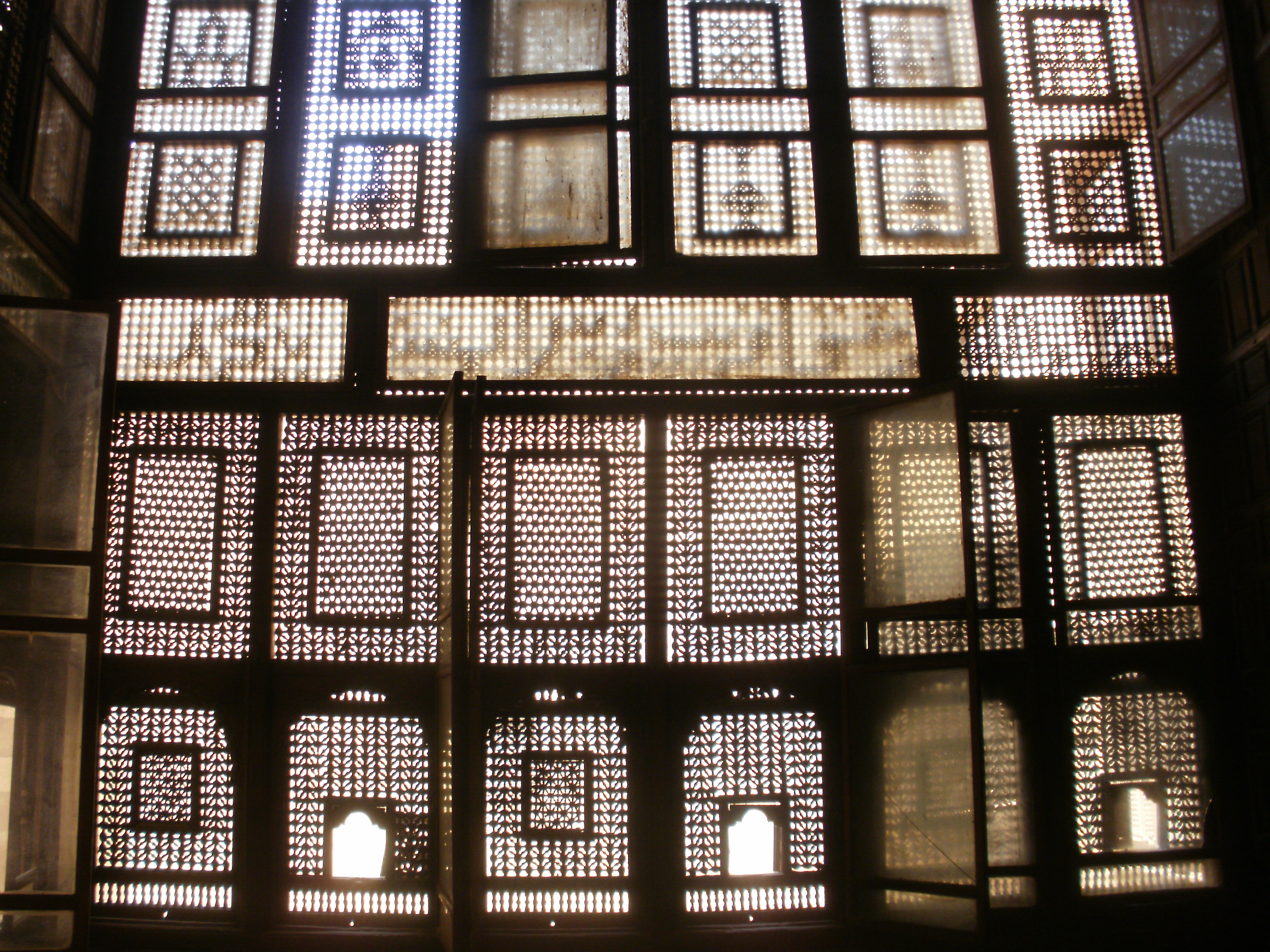
Looking through a traditional mashrabiya, photo by Brett

exciting person. On a scale from one to ten, I crop up somewhere in the middle. Right now, I’m living at home–yawn–researching philosophy PhD programs–super yawn–and brushing up on personal finance and fitness as I set out to join the “real world” with whatever jobs and internships can sustain me for a year–asleep yet?

But one week from today, I drive to the airport, battle through the baggage lines, and hit the air, sandwiched on a stuffy plane, on my second trip to Egypt to teach English.

I’m both nervous and excited.

Continue reading “Thoughts on the Real World”

Feeling “at home”

I spent the last three days traveling to Boston with an old friend and his girlfriend, House picturescouting for apartments. They’ll both be PhD candidates in the fall–one at B.U. and the other at MIT. My old friend called me about a month ago to catch up, and we decided it may be neat for me to move in with them.

I didn’t get into the MFA programs I applied to last winter, and the prospect of a gap year living with my parents at home as I applied to other programs didn’t seem pleasant. My friend agreed. Boston would have plenty of people, schools, and opportunities to explore. I’d be out of the house, living in the world.

The plan was to find a two-bedroom in Cambridge area for a reasonable price. Turns out, it wasn’t that simple.

Continue reading “Feeling “at home””

Clichés and images

In seven days, I put on a cheap, fire-hazard of a cap and gown, shuffle across the Charlie Brown One Nightoverpopulated floor of a gym, grab a mass-produced sheet of sepia-toned paper, and graduate–along with thousands of others in the coming weeks. In the meantime, I have a lot to think about.

I auditioned to be one of the commencement speakers. I don’t think the committee appreciated my attempt to deconstruct the clichés that crowd most ceremonies–those lovely nuggets of wisdom we pocket heading out into the “real word” to find a job because “we’re the future” and “our education is only the beginning.”

“I didn’t think we’d make it,” but we did. Hopefully we’ve “found ourselves” and “remember where we came from” while we’re at it.

I think I’ve made my point…

Clichés are the Easy Mac of our language: artificial, devoid of nutrition, but easy to make. No one really likes clichés, but we use them at important events for well-trod expressions and cheeky adages. They’re quick and malleable. Few of us take the time to truly consider what the event means, or if we do, we can’t find the right words. There’s too much going on.

This is my problem.

I can feel the day approaching, but I don’t know what it means. And I’m not the sort of person who can blithely steps off into mystery like a trust fall. I need some clarity.

Continue reading “Clichés and images”