Being single, day one

I haven’t been single since my sophomore year of high school. I’m currently a junior in college.

Eight months, three years, five months, five months; each one a separate relationship.

So when my (now ex) boyfriend called last night and said, “I just can’t do this anymore,” I breathed a sigh of relief, smiled and agreed with him. I had been thinking the same thing.

We started out strong and had a fun summer together, but my return to school really changed things. I noticed how different he and I are and how we don’t have much in common. We tried to build something substantial around a simple, mutual attraction. It didn’t work.

I could tell our relationship had been failing, but I decided to cling onto the hope that things would return to how they were in the beginning. It was effortless then. I was absolutely crazy about him and knew he felt the same way about me. But it slowly deflated. And instead of owning up to this and breaking it off myself, I waited for him to do it.

Why? Because I’m scared of being alone. 

There. I said it.

I’m scared.

“You’re 19, Em,” my mom says, “you’re fine.

I know I am. So why do I feel this intense pressure to meet someone, fall in love, get married and live happily ever after?

One word: Disney. And all the other happy-go-lucky movies I watched as a child.

It’s their fault I grew up and babbled about my eventual wedding and practically have the whole damn thing already planned.

A text from my brother.

I need to change some things.

I don’t just want to be alone, I want to be okay with being alone.

I don’t want to see my ex with his girlfriend and feel sorry for myself. I want to continue the laughter I had a few weeks ago when he returned to the dining hall with his and her dishes to put in the dish rack. He thinks he’s being a gentleman, but he’s really just stripping her of her independence. (She can do it herself, ya dummy!)

I don’t want to walk around campus looking for my next beau. I want to focus on me and my work. And if something should happen along the way, cool. It shouldn’t be It’s not a priority.

I don’t want to panic anymore. I want to feel secure in my own skin. I owe that much to myself after being a shapeshifter in these relationships over the past five years.

Jane Eyre said, “I am no bird; and no net ensnares me: I am a free human being with an independent will.” 

No net currently ensnares me. Watch me fly away.


Time, art, and negative capability

I found my summers yesterday, in the fall, the whole of them blue-sky bound and strewn with wind. The oak and maple leaves weaved paths like a wandering needle as they settled to the ground, sun-curled and scattered. Meanwhile, the afternoon light shimmered in the shaking leaves like a mirage or a whispered poem.railway-autumn

Legs folded, I sat on a red Adirondack chair, looking at the backyard where I grew up. A few things were different. The white picket fence wasn’t there anymore. My brother and his friends had taken sledge hammers to it some hot day years ago, celebrated with beer, and piled up the boards like felled trees. A wire fence replaced it, rattling in the wind and squaring off the yard like the lines on a chess board.

My grandfather’s old table was gone too. It was old when I was a kid, gray like the weather had bleached the life out of it, while lichen and moss filled the cracks. I used to poke my finger through knotholes and wiggle it, like a worm, legs swinging too high to touch the flagstone patio where the table rested. I don’t know where that went. Maybe firewood. Maybe the soil behind the stand of hemlocks in the back.

There, on that old table, my neighbor and I built planes with computer paper from my dad’s old Macintosh. That’s gone too, or maybe buried somewhere in a dim corner of the basement, beneath rusted wrenches and coffee cans of old nails. Those days, before the wire fences went up, my neighbor would cut through our backyards and knock on our back door. We rarely called. I’d see him on our back step, his hair like a pile of feathers cemented under a baseball cap, and I’d steal the paper.

For the whole summer day, we’d sit out at that table, folding, and cutting, and throwing our planes when the wind blew. Sometimes they weaved, crashed, and tumbled on the ground like drunk pigeons. And other times, the wind caught the frail wings of our creations and carried them up into the blue, blue sky like birds chasing the sun, and we forgot that there were boundaries, forgot that there were fences and time limits.

Yesterday, sitting on that red chair, I found that joy again. I could see the table, the paper, and my neighbor folding planes beside me. Memories pooled in a puddle that never dried up. The images had a deep resonance, like the memory had bounced back from some distant place, bringing echoes as it returned. Time dissolved.

Then, the moment passed, as a gust brought a branch full of yellow leaves sailing down like a dozen paper planes, all weaving, and diving, and settling. I locked back into time again, like a wanderer suddenly brought back to the path.

Continue reading “Time, art, and negative capability”

Egypt: a reaction

When I first read Robert Frost’s poem “Out, Out–“ about a boy getting killed in a chainsaw accident, I cringed at the final sentence: “And they, since they/ Were not the one dead, turned to their affairs.”

Egypt, street scene

How could they be so calloused? I thought. That boy just died, and they “turned to their affairs”?

I now understand that we must often turn to our affairs despite tragedy or else nothing would get done. Held down, scarred over, and silenced with whiteout, our memories remain, but we move on. There’s even a sort of stoic courage there.

Egypt has resurfaced in the news as the violence worsens. As of this writing, the mainstream media has confirmed over 800 people dead since unrest began. That doesn’t count the thousands of injured. The burned churches. The torched and dismantled government buildings. The barricades. The shattered lives. The unconfirmed dead. The fear.

Another teacher I worked with reported on a blog how a priest she knows was riding in car when a man with a knife started chasing him. The fast-thinking driver saved the priest’s life.

“Today this same priest told me that priests in Egypt fear being led like sheep to the slaughter,” the teacher wrote.  

It’s one image in a complicated mosaic.

“It was a hell,” a doctor said about the violence a few weeks ago. I can’t imagine what he’d say now, with hundreds dying and motorcycles carrying bodies back from front lines to makeshift morgues in mosques.

I, too, worry about the friends I made, the places I saw, the people I shook hands with. They are more than statistics. The grease and dust from their hands has washed off, but I still feel it. I still hear their stories, remember their smiles. Every update makes me think of them.

I want to mourn or fight, but I must “turn to my affairs”–so says that voice inside my head, that voice that points to all the practical, at-hand problems I must deal with: loans, money, drivers’ tests, GRE exams, messy kitchens.

I’m getting them done, but my mind is still in Egypt.

Continue reading “Egypt: a reaction”

On Frasier and Leaving The Past Behind

I’ve been watching a lot of Frasier the last few weeks. Maybe it’s a hankering for something funnier than today’s formulaic television comedies, or it’s probably just that the show is wickedly entertaining.

from fanpop.com
from fanpop.com

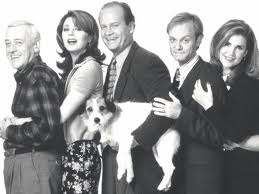
The 90s powerhouse comedy features Kelsey Grammer as the titular Dr. Frasier Crane,a pseudo-intellectual radio psychiatrist trying to get through life despite his multiple character flaws. He’s joined by his equally pseudo-intellectual psychiatrist brother Niles, his retired cop father and his snarky British housekeeper as he weaves through a series of unfortunate shenanigans.

In the episode “Seat of Power,” the Crane brothers attempt to fix a leaky toilet to prove to their father they can do more than recite Faulkner and wax poetic on a particularly good vintage. Of course, they fail miserably and call in a plumber; in a twist, the plumber is one of Niles’s high-school tormentors.

Niles wants no more than to shove his foe’s head into the toilet, giving him a “swirly,” the torture he endured many time in high school. Frasier talks him out of it, instead urging him to tout his success: the “living well” revenge.

When that backfires (the plumber drives a Mercedes and has a fulfilling marriage), Frasier recommends Niles simply talk it out with the bully. Though Frasier ignores his own advice when he takes a toilet-water infused revenge on a second bully-turned-plumber, Niles comes to terms with his aggressor and moves forward, settling some 20 years of pent-up anger.

You may wonder what my point is, but I was struck with how well Niles and Frasier’s misadventure mirrored my own struggles with leaving high school resentments behind.

Continue reading “On Frasier and Leaving The Past Behind”

Starlight and renewal

Sometimes, when I’m tired or lost I look at old writing. It reminds me where I camestars1.jpg from, what has always mattered, and where I ought to go. Today, as I struggled to write a blog post, I sorted through old files and notebooks.

I found this, a reflection from fall of my junior year. It was a hard semester, as I’ve referenced before, but it many ways, it set my foundation. In the midst of that darkness, I found my passions and insecurities. I found my self.

I think this particular reflection captures a lot of that. It also hits at the seed that inspired this entire blog: the fusion of life and philosophy that makes “backyard philosophy.”

I repost it in full below, only edited for grammar. We all need reminders now and then.

Continue reading “Starlight and renewal”

The Quest for Peace

Something I wrote before: “I am not like yesterday. Not yet tomorrow. I am today.” This line returns to me like a long slow breath, stretching syllables until they share the weight of my body and soul.   And then I remember what I lack, what I fear, what I need for “today” to be here with me as my present self. Because tomorrow I will say, “I am not like yesterday.” Thoughts are my enemies, but I learned that peace is something that never ceases to exist. It’s there. But peace is humble; it doesn’t seek our attention. In lieu, we must be the ones to pursue it—or perhaps, realize peace.

The quest for peace in our days is a labyrinth with its dark tunnels and hidden passageways. I am in this maze just as much as you are.  But I have discovered that the peace is the maze itself. Or maybe not? Well, I am still living and learning. Ten or twenty years from now I might assemble a different perspective on peace. But, as of now, I am taking a stop in my travels, so I can let my life stir what it has collected over the years.

Within the stream of my thoughts and endless needs and desires, I can feel the weight of the world dropping on my hands like tiny seeds waiting to be planted in my head. And within my fears and doubts, I can distinguish which seeds I had actually considered to plant ten years ago.

I am not drawn to gardening at all, but if I had the influence, I would. As of now, I am tending the garden in my head and, especially, my heart.

Peace grows where we unite ourselves to the soul of peace.

I don’t want to say the ground of peace or the core of peace, but rather the soul—the soul is its life, its true breath. The soul is an intimate substance. It is where the encounter of our essence and intangibility gaze at each other as lovers do before they depart. The only difference is that the makeup of our soul never leaves—it is us. And we make that precious encounter with peace when we contemplate on its authenticity as opposed to the benefits or outcomes of peace itself. In a similar way, we make that distinctive encounter with ourselves when we contemplate on the intimate reality that we possess in our souls. Not in yesterday’s reasons and excuses or tomorrow’s goals and desires, but today’s moment. Peace is for today; it’s meant for today. And it’s meant for us and it longs for each of our distinctive union.

As I have mentioned before, peace is humble, so it is not ignorant or oblivious to its own beauty and power. As each fear or troubling thought marks its territory in my mind, peace remains quiet and patient because it knows I have to make the effort to enter into its sanctuary.

We must humble ourselves to encounter peace. We must admit our faults and frustrations and realize that there are things in life we do not have control over. Deep inside ourselves, we are vulnerable and powerless. Deep inside ourselves, we fail to remember our human quality which is truly vital to recognize as we face our struggles and disappointments. But, we, most importantly, overlook the active presence of our soul that is oftentimes deadened by our fleeting pursuits of unnecessary and damaging ambitions. And, yet, peace still waits for us. Underneath, above, in between our angst and fears and concerns—peace is there. It exists. It exists. It exists.

Empty blue mattresses

June 24, 2011. Blue and white caps and gowns dotted the football field. From my chair in the front row, I remember thinking to myself, “I will never be in the presence of this exact group of people ever again.” 

Since then, I can count on one hand how many people from my high school graduating class I’ve gone out of my way to see since that June evening over two years ago (the answer is three –– not kidding).

But my lack of friends from high school is an entirely different matter; the real point here is that there are moments we seriously can never get back. And places, too. Physical locations are just as important.

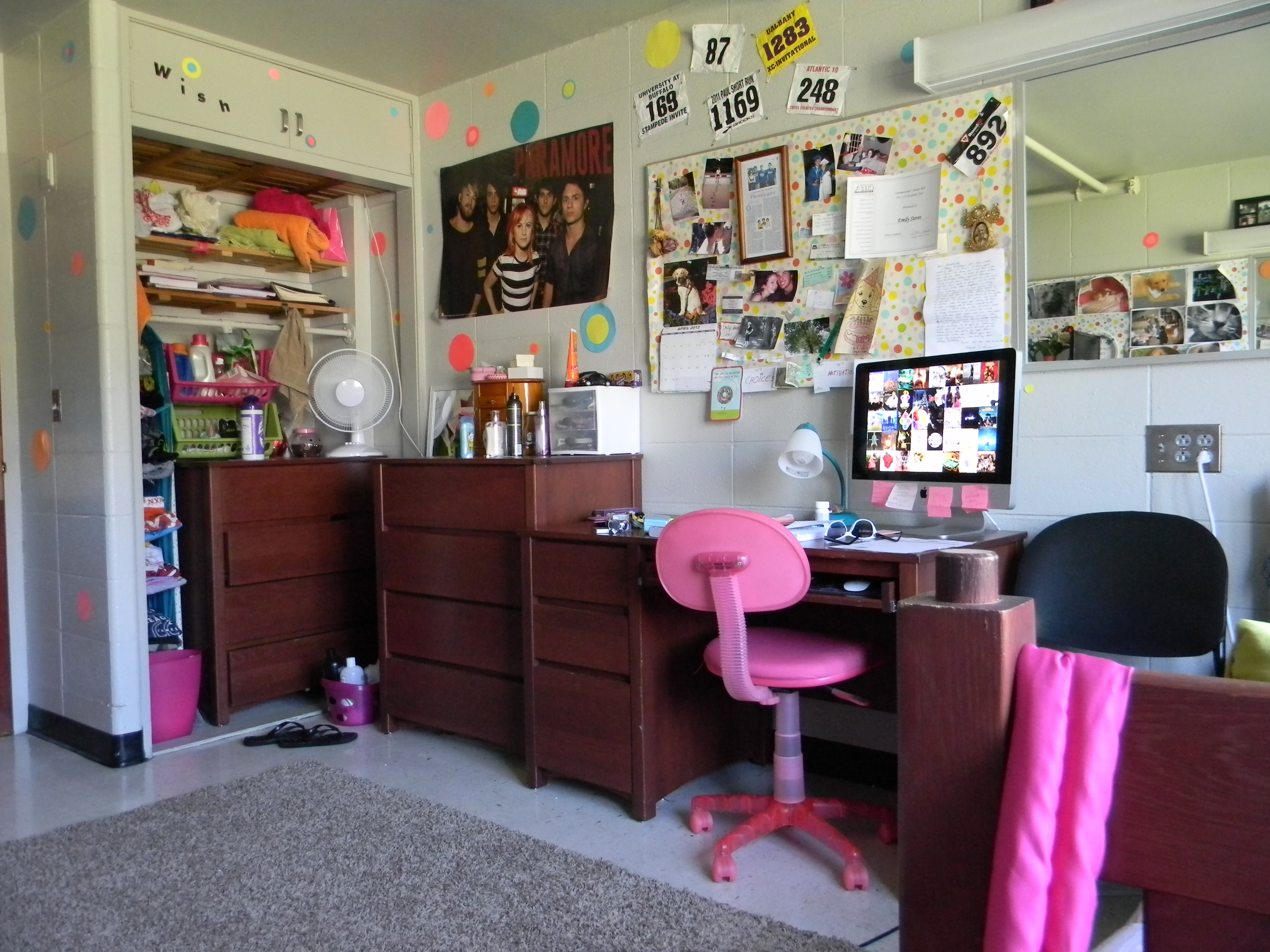
Polka-dots galore, welcome to my freshman dorm room.

I adored my freshman year dorm room. I have so many memories trapped within the walls of room 157 in Loughlen Hall. My friends and I watched Jenna Marbles videos and snuggled in my bed. We got fancy with wine the night before one of my finals and shoveled handfuls of classy taco cheese down our throats, the next-best thing to Gruyère.

It hits me when I remember that room doesn’t exist anymore. And some of those people in the memories don’t even attend the university now. We’ll never recreate that group of people or the place we once called “home.” The then-polka-dotted walls are back to their original white cinder-block state, with lonely bed frames housing empty blue mattresses.

I’m currently in limbo, picturing my dorm room from this past year instead of looking forward to a new white box to call my home. And what I’m thinking of and picturing doesn’t even really exist anymore. The frame does, the touches that made it Emily’s Room don’t.

Next time you’re in a group of friends, look around. Memorize facial expressions and laughter. Take the time to discover what each person contributes to the gathering and ponder what it would be like if he/she were not there. How do your surroundings make an impact? What if you could never return to that particular place? You’re living in a moment that may never present itself again. Cherish it.

I hope that if/when my parents sell my childhood home, the new owners take the time to look it over and imagine bare feet tearing through the different rooms and up the staircase. I know I will be.

The minute that “SOLD” sign is posted, I’ll have lost access to a portal containing countless memories; one that can never be reopened once sealed.

Carl Sagan

I’m a bit of a Carl Sagan junkie. I suppose it started the evening before Thanksgiving Carl_Sagan_Planetary_Societybreak my junior year, when my ride changed plans to leave the next morning. With an evening free, I scanned HULU for a show to kill time with. It recommended Cosmos, and after reading the glowing comments, I decided to check it out.

The name Carl Sagan was familiar, and I had seen his parted hair, turtleneck, and beige jacket parodied on television. I had also heard his famous Pale Blue Dot monologue at a talk from Bill Nye, who respected Sagan. I even met a professor from Cornell who got his office, replete with a hidden foot pedal to call campus police for unwanted visitors.

But the pieces didn’t connect.

The strangely nostalgic piano and synth-string theme played over an intro of star fields and passing nebula. The café around me softened into a whimpering white noise of scuffing tables, chatting workers, and clattering cups. Sagan spoke, his iconic cadences seeming to pick out words with the precision of tweezers.

“The sky calls to us,” he said. “If we do not destroy ourselves, we will one day venture to the stars.”

Continue reading “Carl Sagan”

Thoughts on friendship

Tonight, I go on my fifth annual road trip with a few high school friends. The six of us

From the Painting "Kindred Spirits."
From the Painting “Kindred Spirits.”

met in seventh and eighth grade making films. Now and for the past four years we’ve been going in separate places: different schools, different interests, different cities–even states.

Still, something has held us  together, for the past eight years. Sometimes, that’s hard to believe.

Dunbar’s number dictates we can only keep track of around 150 beings at any given time. If they’re too distant, they don’t make the cut and blur behind a thin haze of anonymity.

During our lives, few people make the cut. Those who do so consistently become friends.

Friendship has the rare honor of being part of “the human condition,” the seemingly universal and timeless experience that defines what it means to be human. I don’t know if anyone has ever tried to outline our condition, but I imagine that friendship would be on the list somewhere.

Despite it’s prevalence, however, friendship remains a brittle obscure topic. As Thoreau opens in his essay Friendship, “Friendship is evanescent in every man’s experience, and remembered like neat lightening in past summers.” It takes place for all of us, sometimes for just a fragile collection of moments. Yet we can barely describe what makes it so essential.

Continue reading “Thoughts on friendship”

Back home

I’ve been home for about three days now after surviving over 24 hours traveling, sustained by Cliff Bars, airline food, and caffeine. My mom barely held her tears in as she squeezed me near the baggage counter in the echoing spaces of the near-empty airport. The rest of the flight pooled around the carousel, frayed and wrinkled.

“It’s good to be home,” I said.

And it was. Four days before, June 30th arrived after weeks of warnings, anticipation, and scattered protests. Like a ruptured pipe, millions pooled into the squares and streets across Egypt. Tamarod, the grass-roots movement that organized the opposition, flaunted 22 million signatures to throw out Morsi while Tagarod, the pro-Morsi opposition, organized sit-ins.

As some graffiti said, “January 25 and June 30, our Revolution continues.”

Flags, fireworks, clenched fists, posters, and red cards colored the crowds. Couples, children, and friends held cards reading “Leave.” In a country with notorious disregard for timeliness, organization, and teamwork, millions gathered with a single purpose.

“It is the biggest protest in Egypt’s history,” one official told Agence France-Presse.

Continue reading “Back home”