Birth of a Francophile

An older piece that used to be another blog that is, alas, no more. I found it again today, made some edits, and decided to post it, being an old favorite of mine. Enjoy:

I sat around reading warning labels as a kid. Maybe some kids played basketball or kickball. Nope. Not me. That’s where I first learned French.

The words were musical. Though they burbled from my lips in coagulated lumps of mangled forms, I sensed the potential for improvement. For lush vowels and fluid links. Of course I had no idea what they meant, either.  Attention! I said to my dad. Regardez! Gonflable! The last one means airbags, in case you’re wondering.

I started taking French in middle school. My teacher was a lean woman with a face like Edith Piaf and frenetic red hair that never changed, as is suspended in perpetual clothes-folding static. A lyricist of French grammar, she sang songs about the imperfect tense to the tune of jingle bells, and if we misbehaved, she swore in Greek under her breath.

Continue reading “Birth of a Francophile”

Five books that made me

As the American Transcendentalist Ralph Waldo Emerson once wrote (or so the various quote websites have us believe),“I cannot remember the books I’ve read any more than the meals I have eaten; even so, they have made me.” So it is with me. books picture

A confirmed bibliophile, I may not be a surprising case, but I’ll never forget one of my co-workers at Lowes. An older man with rough hands, worn blue jeans, and work boots, he rasped contracting stories in a cigaret-stained voice about “idiots who didn’t know shit about construction.” 

But one day, during his break, when I was reading Don Quixote over a turkey sandwich, he sat down and started talking about books. Books he read in school, like Hemingway, Austen, Faulkner, and Dickens. Books his wife read, like Jody Piccoult and John Grisham. Books his father gave him, worn how-to manuals and beat-up hardcovers gathered from outdated encyclopedia sets.

“I miss reading,” he said, leaning back in his metal fold-out chair. “I miss the stories.”

Soon, I went back to the registers, thinking about it. Probably nothing would happen. But a few weeks later, he came in and pulled out a worn copy of the The Old Man and the Sea.

“My favorite,” he said. “I’ve never forgotten this book.”

Since then, I haven’t either.

Continue reading “Five books that made me”

Hiatus over

Hey all, I think I’m finally back from my hiatus. I apologize. I had a busy semester, coupled with a persistent clinical depression. But now, with summer here, I’m ready to start posting again.

Me this summer. [image from genio]
I figured this blog will offer a great chance for me to work through some summer projects. In addition to my summer jobs and the day-to-day concerns of life, I have three things in particular I’ve been working on:

1. My thesis groundwork: I’ll be writing about composition theory, ideally focusing on critical pedagogy, and where critical pedagogy intersects with new digital concerns, like online classes, content generation, and multi-media writing (or multimodal composition, to use the fancy term).

What is critical pedagogy? Probably a good topic for a later post. But in general, it’s an attempt to use education to empower marginalized or “oppressed” individuals and populations. One of its foundational texts–if not the foundational text–is Paulo Friere’s Pedagogy of the Oppressed (1968, trans. 1970), where Friere argues for a more “humanizing” role for education, breaking the “culture of silence” created by traditional education and the oppression for the poor that it creates.

2. Writing about Egypt and the Egyptian Revolution: My major creative project for this summer will be an exploration of Egypt and the turmoil that has haunted it the past few years (or longer, really), weaving the personal, the journalistic, and the academic. It’s a mutual project with another friend, who also has a lot invested in the Middle East and the Arab Spring. I hope to begin by looking at some of my older pieces, reading the news in depth, and building from there.

3. Figuring out the next step: I graduate next May, with my English M.A. From there, I’m not yet sure what I’m doing. I may go straight to PhD, in either rhetoric and composition or philosophy. I may stay home, trying to make some money as I figure things out. I may also look at AmeriCorps, Fullbright, or Teach for America. As of now, these are all viable possibilities, requiring research.

How these three projects will come together remains equally uncertain. I can already see a few links worth exploring. I’m looking forward to writing again. In the meantime, have a good day.

-Brett

Zen and everyday life

lotus_flower
[Image from North Dakota State University]
I had plans for another post today, in light of a fellow blogger nominating me for a Liebster Award. But a night at a Franciscan retreat center has prompted me to write something a little different.

Since I first learned about Buddhism in high school, I’ve been interested in it. I still remember filling out answers to the Four Noble Truths on quizzes in the front of my ninth grade class, alongside sanskrit terms.

Since then, I’ve come a long way.

An independent study in Buddhist philosophy, numerous books, a few meditation retreats, and a daily meditation practice that lasted a few years have all increased my awareness in Buddhism, especially Zen.

But two winters ago, my interest culminated in a three day retreat at a Zen monastery in the Catskills. I still recall the final day of the retreat. After the exhausting stints of 5 a.m. zazen meditation and work projects–where I silently cracked over a hundred eggs–we concluded with a koan and a dharma talk by the sensei. The koan was about the diamond sutra, a central text in Mahayana Buddhism, called “diamond” because a true understanding allows one to cut through illusion and ignorance like a diamond.

The sensei brought up the ending of the sutra itself:

“So I say to you – 
This is how to contemplate our conditioned existence in this fleeting world:”

“Like a tiny drop of dew, or a bubble floating in a stream; 
Like a flash of lightning in a summer cloud, 
Or a flickering lamp, an illusion, a phantom, or a dream.”

“So is all conditioned existence to be seen.”

Thus spoke Buddha.

Building on the Buddhist notion of impermanence–that life contains unceasing flux and change–the sensei stressed our need to “leave no footprints” as we moved through life, negotiating the tricky balance of “equanimity,” a peaceful abiding between aversion and desire that does not fall into indifference. Life is indeed brief. It is full of change and interdependence. Like a dream, things come and go.

Sitting in zazen position, legs folded and “heart open,” I felt a change. Buddhism traditionally has different levels of understanding, ranging from the merely intellectual to the silent but sure understanding of an Enlightened one. Somewhere between lies a heart understanding, where one truly “feels” a new insight that cannot fit into words.

In the midst of the dharma talk, I felt that insight.

Continue reading “Zen and everyday life”

Introverts and the holidays

First of all, happy New Year. Perhaps 2013 was a down-and-out scrape to get through or an idyllic gallop on the pig’s back. Whatever the case, it’s ended and a new window aglow with resolutions awaits. But since New Years resolution posts have already flooded the internet, I wanted to write about another timely topic: being an introvert during the holidays.

I don’t handle holidays well. The noise, social obligations, tedious traditions, ostentatious meals, and blitzkrieg shoppers exhaust and overwhelm me. Each year as Christmas crawls around, my stomach knots up with dread. And the past few years I’ve reached saturation points, where at the end of a long string of busy days, I crash like stretched out spring ripping back into place. I cannot put on the act any longer.

With the holiday season on the wane, I can say that I survived this year. It took an effort, but in the end, this was the best holiday season I’ve had in a while. Perhaps some of you weren’t so lucky. In that case, here are a few ideas that helped me.

Continue reading “Introverts and the holidays”

Unsticking

I’ve been stuck lately. It happens to all of us. Now and then, we feel like Dante, who lastleafopens his Divine Comedy in the midst of an existential crisis:

IN the midway of this our mortal life,
I found me in a gloomy wood, astray
Gone from the path direct. . .

Fortunately, most of us don’t need to walk through hell and purgatory before we reach the heaven on the other side. And we don’t need to need to wander between dream vision and sleep, gradually learning how to “do well” like William Langland’s protagonist in Piers Plowman. 

But what these texts from the Middle Ages note remains true: sometimes we lose our momentum. Like a turtle pushed out to the center of a frozen pond, unable to gain footing and reach the shore again, we feel lost, adrift, and powerless. Sometimes, this makes us stiff and wooden. As Albert Camus writes in his essay “Return to Tipasa“:

A day comes when, thanks to rigidity, nothing causes wonder any more, everything is known, and life is spent in beginning over again. These are the days of exile, of desiccated life, of dead souls. To come alive again, one needs a special grace, self-forgetfulness, or a homeland.

Indeed, sometimes we really do need to come alive again.

Continue reading “Unsticking”

Sisyphus and the fair field full of folk

Yesterday, while sitting in the cafeteria, sipping the last of my tea, I scanned the seething mob of students around me. Pockets collected around tables, laughing. Some weaved through the rows of chairs, balancing plates. Most were focused, making beelines through the groups, mumbling excuses and smiling as they dodged bodies and carts, slipping into their own chair. Others took their time, stopping at tables, picking out apples like a chef at a farmer’s market.

Image courtesy of Vanderbilt library

Each person had a way of being. Some wore exercise clothes, others had prim button-down Oxfords, most shuffled through lines in pajamas. They had places to go, things to do–or an absence of things to do that they filled with conversations and distractions.

Having spent the morning reading William Langland’s Piers Plowman, an allegorical dream poem from the 14th century, I recalled one of the more famous lines. The narrator, a mysterious figure named Will, falls asleep and finds himself in the midst of a strange country. He describes it:

I saw a tower on a toft · worthily built; 
A deep dale beneath · a dungeon therein, 
With deep ditches and dark · and dreadful of sight 
A fair field full of folk · found I in between, 
Of all manner of men · the rich and the poor, 
Working and wandering · as the world asketh. 

Will then goes on to describe these “fair folk.” Some toil in fields, while “Wasters” devour their products in gluttony. Some seek after salvation, becoming monks and anchorites; others wear the habit as a means to a escape poverty and cheat others. Merchants sell wares. Pilgrims travel. Kings rule, judges judge.

The poem describes a diverse spectrum of life, from highborn to low, and sandwiched them between these two towers: the one on a hill, the other in a ditch. We later discover that the tower on the hill is the tower of Truth, a symbol for God and salvation. The tower in the ditch belongs to Wrong, providing a symbol for a wasted life and a doomed afterlife. As the poem progresses through it’s many “steps,” visions chronicle Will’s search for salvation through Truth.

In the cafeteria, I considered Will’s vision, particularly this “fair field full of folk,” buzzing, weaving, laughing, and living around me. Where are they all going? I thought. What are they doing? Why are they here? A surge of compassion welled up in me as these questions turned over in my head, rolling one to the other. I felt connected to everyone and detached at the same time, an outside observer with a unique stake in the observation.

Continue reading “Sisyphus and the fair field full of folk”

Time, art, and negative capability

I found my summers yesterday, in the fall, the whole of them blue-sky bound and strewn with wind. The oak and maple leaves weaved paths like a wandering needle as they settled to the ground, sun-curled and scattered. Meanwhile, the afternoon light shimmered in the shaking leaves like a mirage or a whispered poem.railway-autumn

Legs folded, I sat on a red Adirondack chair, looking at the backyard where I grew up. A few things were different. The white picket fence wasn’t there anymore. My brother and his friends had taken sledge hammers to it some hot day years ago, celebrated with beer, and piled up the boards like felled trees. A wire fence replaced it, rattling in the wind and squaring off the yard like the lines on a chess board.

My grandfather’s old table was gone too. It was old when I was a kid, gray like the weather had bleached the life out of it, while lichen and moss filled the cracks. I used to poke my finger through knotholes and wiggle it, like a worm, legs swinging too high to touch the flagstone patio where the table rested. I don’t know where that went. Maybe firewood. Maybe the soil behind the stand of hemlocks in the back.

There, on that old table, my neighbor and I built planes with computer paper from my dad’s old Macintosh. That’s gone too, or maybe buried somewhere in a dim corner of the basement, beneath rusted wrenches and coffee cans of old nails. Those days, before the wire fences went up, my neighbor would cut through our backyards and knock on our back door. We rarely called. I’d see him on our back step, his hair like a pile of feathers cemented under a baseball cap, and I’d steal the paper.

For the whole summer day, we’d sit out at that table, folding, and cutting, and throwing our planes when the wind blew. Sometimes they weaved, crashed, and tumbled on the ground like drunk pigeons. And other times, the wind caught the frail wings of our creations and carried them up into the blue, blue sky like birds chasing the sun, and we forgot that there were boundaries, forgot that there were fences and time limits.

Yesterday, sitting on that red chair, I found that joy again. I could see the table, the paper, and my neighbor folding planes beside me. Memories pooled in a puddle that never dried up. The images had a deep resonance, like the memory had bounced back from some distant place, bringing echoes as it returned. Time dissolved.

Then, the moment passed, as a gust brought a branch full of yellow leaves sailing down like a dozen paper planes, all weaving, and diving, and settling. I locked back into time again, like a wanderer suddenly brought back to the path.

Continue reading “Time, art, and negative capability”

Egypt: a reaction

When I first read Robert Frost’s poem “Out, Out–“ about a boy getting killed in a chainsaw accident, I cringed at the final sentence: “And they, since they/ Were not the one dead, turned to their affairs.”

Egypt, street scene

How could they be so calloused? I thought. That boy just died, and they “turned to their affairs”?

I now understand that we must often turn to our affairs despite tragedy or else nothing would get done. Held down, scarred over, and silenced with whiteout, our memories remain, but we move on. There’s even a sort of stoic courage there.

Egypt has resurfaced in the news as the violence worsens. As of this writing, the mainstream media has confirmed over 800 people dead since unrest began. That doesn’t count the thousands of injured. The burned churches. The torched and dismantled government buildings. The barricades. The shattered lives. The unconfirmed dead. The fear.

Another teacher I worked with reported on a blog how a priest she knows was riding in car when a man with a knife started chasing him. The fast-thinking driver saved the priest’s life.

“Today this same priest told me that priests in Egypt fear being led like sheep to the slaughter,” the teacher wrote.  

It’s one image in a complicated mosaic.

“It was a hell,” a doctor said about the violence a few weeks ago. I can’t imagine what he’d say now, with hundreds dying and motorcycles carrying bodies back from front lines to makeshift morgues in mosques.

I, too, worry about the friends I made, the places I saw, the people I shook hands with. They are more than statistics. The grease and dust from their hands has washed off, but I still feel it. I still hear their stories, remember their smiles. Every update makes me think of them.

I want to mourn or fight, but I must “turn to my affairs”–so says that voice inside my head, that voice that points to all the practical, at-hand problems I must deal with: loans, money, drivers’ tests, GRE exams, messy kitchens.

I’m getting them done, but my mind is still in Egypt.

Continue reading “Egypt: a reaction”

On Frasier and Leaving The Past Behind

I’ve been watching a lot of Frasier the last few weeks. Maybe it’s a hankering for something funnier than today’s formulaic television comedies, or it’s probably just that the show is wickedly entertaining.

from fanpop.com
from fanpop.com

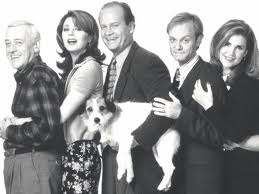
The 90s powerhouse comedy features Kelsey Grammer as the titular Dr. Frasier Crane,a pseudo-intellectual radio psychiatrist trying to get through life despite his multiple character flaws. He’s joined by his equally pseudo-intellectual psychiatrist brother Niles, his retired cop father and his snarky British housekeeper as he weaves through a series of unfortunate shenanigans.

In the episode “Seat of Power,” the Crane brothers attempt to fix a leaky toilet to prove to their father they can do more than recite Faulkner and wax poetic on a particularly good vintage. Of course, they fail miserably and call in a plumber; in a twist, the plumber is one of Niles’s high-school tormentors.

Niles wants no more than to shove his foe’s head into the toilet, giving him a “swirly,” the torture he endured many time in high school. Frasier talks him out of it, instead urging him to tout his success: the “living well” revenge.

When that backfires (the plumber drives a Mercedes and has a fulfilling marriage), Frasier recommends Niles simply talk it out with the bully. Though Frasier ignores his own advice when he takes a toilet-water infused revenge on a second bully-turned-plumber, Niles comes to terms with his aggressor and moves forward, settling some 20 years of pent-up anger.

You may wonder what my point is, but I was struck with how well Niles and Frasier’s misadventure mirrored my own struggles with leaving high school resentments behind.

Continue reading “On Frasier and Leaving The Past Behind”